en.Wedoany.com Reported - Qualcomm Japan held a 6G media roundtable on June 24, themed "Future Technology Vision for 6G – Qualcomm's Perspective." 6G is planned for commercial deployment around 2030, with the mobile communications standardization organization 3GPP having officially initiated standardization discussions. The International Telecommunication Union Radiocommunication Sector (ITU-R) defines 6G as IMT-2030 and is advancing overall research on communication requirements and frequencies. At the event, Qualcomm presented a wide range of content, from an overview of 6G to the forefront of 3GPP discussions.
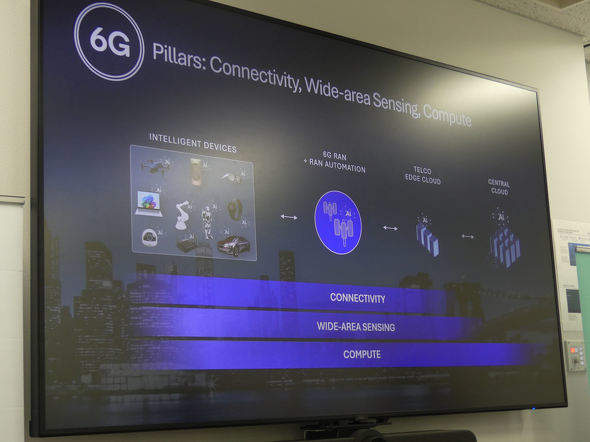
Masakazu Shirota, Head of Standardization at Qualcomm Japan, outlined the 6G overview. He noted that the 3G era brought paradigm shifts, 4G enabled broadband and gave rise to smartphones, and 5G entered an era of unlimited data capacity. 6G is positioned as "6G for the AI era," but he added that the 6G air interface itself is not AI, and it is inappropriate to simply say "6G is AI." Qualcomm proposes three pillars for 6G: Connectivity, Wide-area Sensing, and Compute. In terms of connectivity, 3GPP will introduce new technologies to enhance performance, and 6G will achieve a certain degree of higher speed. Wide-area sensing is a new technology that visualizes objects through communication infrastructure. For compute, Qualcomm envisions distributed computing across the entire network, from edge devices to the cloud, enabling the network to efficiently handle AI-related computations.
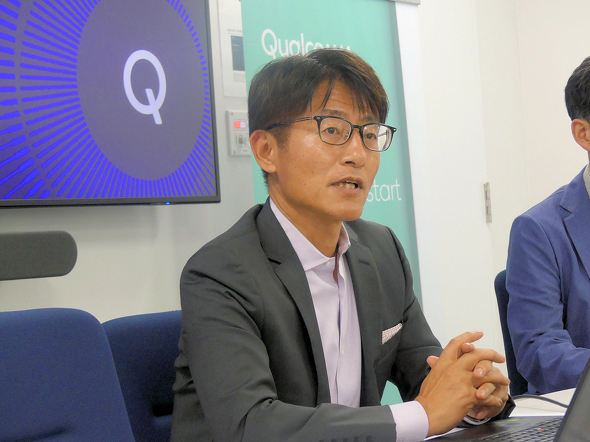
Shirota emphasized that frequencies are extremely important for 6G. Currently, the core allocated frequency band for 6G is expected to be the 6.5 GHz to 7 GHz band, which has been decided or largely decided upon by Europe, India, Australia, China, and others. The United States uses this band for Wi-Fi and is planning to prepare new frequencies for 6G. He pointed out that the way frequencies are used is crucial, and existing 5G frequency bands may not be sufficient to fully enhance 6G performance. Additionally, 5G and previous generations placed more emphasis on downlink traffic, but AI-based traffic patterns require increased uplink capacity, necessitating new frequency bands. Introducing new technologies and capabilities to deploy systems in new frequency bands also justifies operator investments.
Unlike other countries gradually determining frequency usage, Shirota expressed concern that Japan has not yet publicly discussed this matter. The 6.5 GHz to 7 GHz band in Japan is already heavily used by other systems, making coexistence and sharing a challenge. Shirota noted that under Japan's safety-first principle, discussions on frequency sharing appear very conservative. He stated that at the Wireless Technology Park frequency session held in May, Qualcomm deliberately invited key figures from other countries to take the stage, joining the industry in conveying the current situation to the Ministry of Internal Affairs and Communications, hoping that Japan will thus initiate 6G frequency discussions.
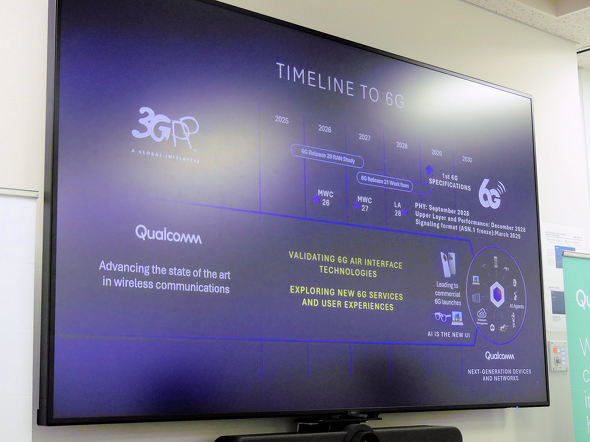
3GPP is still developing 6G specifications, with the first specifications expected to be completed in early 2029. Qualcomm has announced that it will align with this timeline and release a 6G-supporting chipset in the second half of 2029.
Shirota predicts that with the proliferation of AI agents on smartphones, traffic patterns will change, and uplink capacity will increase. Physical AI, used in robots and mobile devices, requires powerful computing capabilities. Qualcomm advocates that not only should robots handle computations themselves, but the network side should also possess computing capabilities and appropriately distribute them to support increased uplink traffic. Shirota stated that this view has not yet been widely shared and hopes the industry will advance it together. Drawing a parallel to the lack of understanding when 5G was introduced to factories, he believes physical AI may face similar challenges. The perspective itself is accurate, but further discussions with the physical AI industry are needed.
This article is compiled by Wedoany. All AI citations must indicate the source as "Wedoany". If there is any infringement or other issues, please notify us promptly, and we will modify or delete it accordingly. Email: news@wedoany.com