en.Wedoany.com Reported - The Open Compute Project (OCP) Foundation's Future Technology Initiatives (FTI) has released a global community framework that defines the core architectural, mechanical, thermal, and electrical integration rules required for deploying Quantum Processing Units (QPUs) in operational data centers and automated AI factories. This joint white paper, co-authored by a multi-institutional alliance including the National Quantum Computing Centre (NQCC), Dell Technologies, NVIDIA, IBM, Pasqal, Qblox, D-Wave, IonQ, IQM, and Diraq, redefines quantum systems from isolated laboratory hardware into modular, rack-schedulable enterprise infrastructure assets.
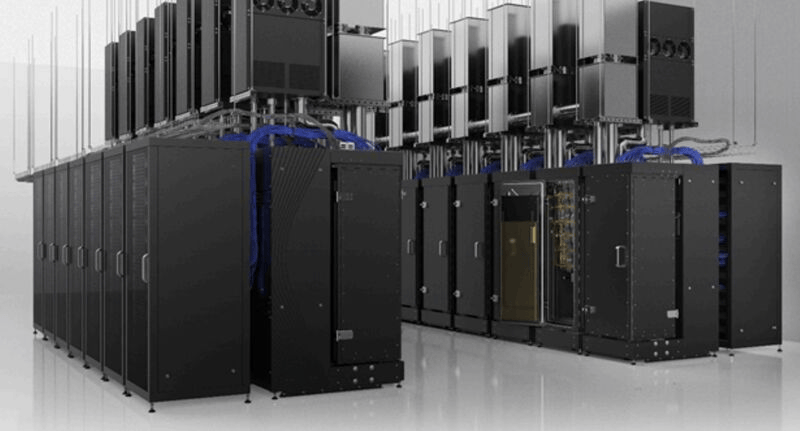
This standardization framework emerges as the strategic planning horizon for enterprise data center facility development has expanded from the traditional 2 to 3 years to 5 to 10 years, requiring operators to pre-build "quantum-ready" server bays to avoid future asset stranding. As quantum processing architectures evolve from Noisy Intermediate-Scale Quantum (NISQ) to Fault-Tolerant Quantum Computing (FTQC), deployment demands a significant expansion of local classical co-processing nodes. Quantum operations are inherently hybrid, requiring tight synchronization with ultra-low latency classical compute pools to execute hardware-aware circuit compilation, pre-processing optimization, single-shot post-selection filtering, and real-time algorithmic error correction.
For advanced surface code topologies, the physical-to-logical qubit ratio scales quadratically with the target code distance, posing immense classical processing challenges during real-time syndrome extraction (detecting qubit phase and bit-flip errors without disturbing the logical data state). To compute corrective operations within the hardware's stringent coherence window, data centers need to deploy localized accelerator pools, such as high-density liquid-cooled Dell XE9780 or NVIDIA GB200 NVL72 systems, directly connected to quantum controllers via high-bandwidth PCIe switches. It is projected that enterprise fault-tolerant operations will generate approximately 100 terabytes per second (TB/s) of error correction metadata, forcing data center architects to redesign local storage hierarchies, likening quantum installations to high-speed flight data recorders where write-intensive storage scaling is directly driven by operational qubit-hours.
The OCP framework subdivides facility planning requirements based on the physical characteristics and environmental sensitivities of different qubit modalities. Solid-state architectures (such as superconducting, annealing, and silicon spin systems) require deep cryogenic operating environments, with physical QPUs packaged inside multi-stage closed-loop dilution refrigerators to cool the solid-state processors to a baseline of 10–20 mK (single-digit millikelvin). This demands structural floor load capacities of up to 1000 kilograms per square meter (kg/m²), along with chilled water piping (10–28°C) for high-power compressors. Matter-based systems (neutral atom and trapped ion modalities) isolate atoms or ions within ultra-high vacuum chambers, controlled by ultra-precise laser configurations, imposing strict constraints on ground vibration propagation and ambient temperature drift (ΔT<2°C over 48 hours). This requires reinforced concrete slab flooring and transport infrastructure isolation from mechanical waves (limiting vibration velocity to below 12.5–50 μm/s), along with cleanroom controls. Fiber-based architectures (such as ORCA Computing arrays) and negatively charged nitrogen-vacancy (NV⁻) centers in diamond lattices (such as the Quantum Brilliance platform) offer the highest compatibility with existing commercial infrastructure, operating effectively at ambient room temperature and directly fitting into standard 19-inch data center racks with moderate power consumption (0.3–3 kW).
The release of the OCP framework marks a critical evolutionary milestone for the global quantum market. The current funding environment reflects a structural capitalization model, where large-scale government, academic, and industrial research grants de-risk early-stage venture capital, transforming specialized QPU manufacturers into complex system integrators. Data center tenants are shifting procurement criteria from raw physical qubit counts to enterprise-grade Service Level Agreements (SLAs), focusing on automated multi-frequency calibration cycles, predictable Mean Time Between Failures (MTBF), minimized system restart latency, and localized containment of stray electromagnetic and radio frequency (RF) field emissions.
To optimize system energy efficiency, the industry is exploring distributed infrastructure designs, such as Maybell's centralized cryogenic plant architecture, which consolidates individual rack-level compressors into a unified liquid helium refrigeration layer capable of supplying cold head lines to multiple adjacent quantum server slots simultaneously. By establishing unified mechanical boundaries, power telemetry standards, and logical control plane interfaces through an open alliance, enterprise computing divisions are building standardized modular supply chains to scale heterogeneous computing resources globally.
This article is compiled by Wedoany. All AI citations must indicate the source as "Wedoany". If there is any infringement or other issues, please notify us promptly, and we will modify or delete it accordingly. Email: news@wedoany.com