South Korea's Hanbat National University Develops Predictive Model for Exciton Properties in 2D Perovskites
en.Wedoany.com Reported - A research team from the Department of Materials Science and Engineering at Hanbat National University in South Korea has systematically revealed the regulatory mechanism of the organic spacer layer's dielectric screening environment on the exciton properties of two-dimensional perovskites, providing a predictive modeling framework for the design of related optoelectronic materials.
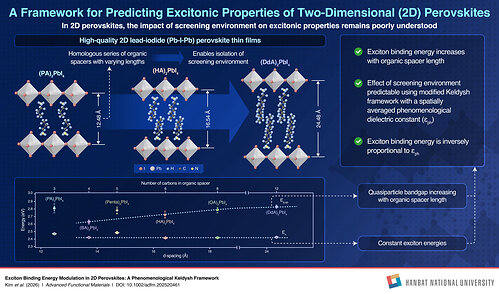
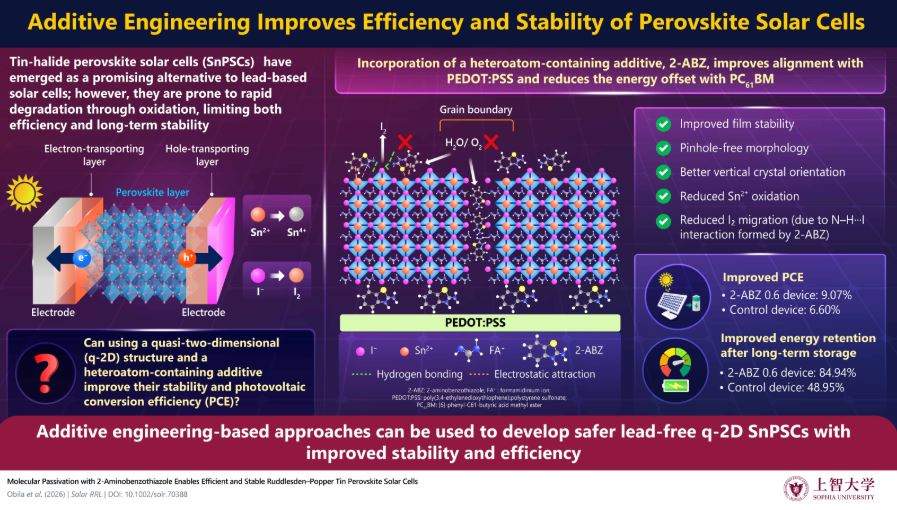
Two-dimensional perovskites, with their alternating inorganic-organic structure, offer superior stability and excitonic effects compared to traditional two-dimensional or three-dimensional materials, and are considered promising for next-generation optoelectronics. However, their luminescent properties are governed by complex quantum and dielectric confinement effects induced by surrounding layers. The precise impact of the dielectric screening environment on excitons was previously unclear, hindering predictive modeling and rational design of these materials.
The research team, led by Professor Ki-Ha Hong, employed a series of structurally consistent organic spacer layers to adjust the interlayer spacing while minimizing structural distortion, thereby isolating the influence of the dielectric screening environment. The study was published online on December 9, 2025, in Advanced Functional Materials and officially appeared in Volume 36, Issue 30 of the journal on April 13, 2026.
The researchers fabricated high-quality two-dimensional lead iodide perovskite films, focusing on even-numbered organic spacer layers with varying alkyl chain lengths. Analysis via photoelectron spectroscopy and UV-Vis absorption spectroscopy revealed that as the spacer length increased, the quasiparticle bandgap widened, while the exciton energy remained nearly constant, leading to a significant increase in the exciton binding energy. The standard Keldysh model failed to fully reproduce this behavior, but by introducing a phenomenological dielectric function that accounts for the finite thickness of the organic spacer layer, the team successfully matched the experimental data, establishing a validated framework for predicting exciton properties.
"This model provides a practical design rule for predicting how the length of the organic spacer layer controls the exciton properties of two-dimensional perovskites," said Professor Hong. "It offers molecular-level design guidelines for tuning the exciton binding energy and energy levels in two-dimensional perovskites, which can guide the future design of materials for light emission, photovoltaics, and other optoelectronic applications."
Related Products


6kV-35kV Medium and High Voltage Direct-Connected Energy Storage System
Hainan Jinpan Smart Technology Co., Ltd.
IGBT Hydrogen Production Power Supply - High Power Air Cooling
Beijing Zhengzhuo Engineering Technology Co., Ltd.


Jiujiang Pinggang 125MW Subcritical Gas Power Generation Project
Capital Engineering & Research Incorporation Limited


0.66kV Power Supply Instrument Transformer
Guangdong Sihui Instrument Transformer Works Co., Ltd.