China Mobile Leads the Establishment of the Industry's First AI-eSIM Industrial Collaboration Platform
en.Wedoany.com Reported - On July 3, at the China Information and Communication Industry Development High-Level Forum, the "AI-eSIM Professional Committee of the China Association of Communication Enterprises," initiated by China Mobile, was officially established. This committee is positioned as the industry's first AI-eSIM industrial collaboration platform, with China Mobile IoT Company serving as the chair unit, and Tianyi IoT, Unicom Huasheng, Volcano Engine, Tencent Cloud, and Guan'an Information as vice-chair units.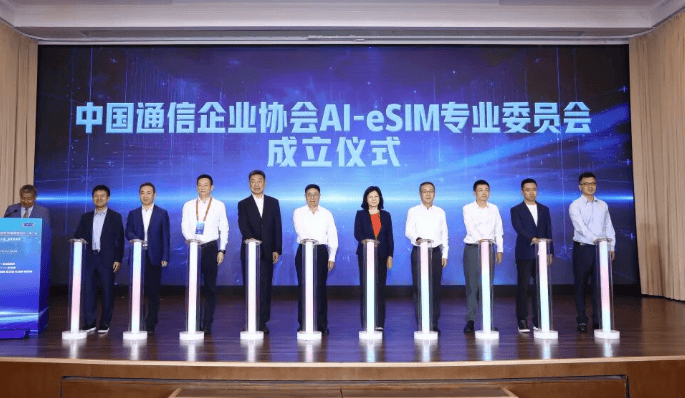
AI-eSIM is integrating traditional communication connectivity capabilities with AI model services, terminal identity, security management, and token operations. Traditional SIM cards primarily handle user identity recognition and network access functions, while eSIM further eliminates the physical card form, allowing devices to complete network activation and operator switching through remote configuration. AI-eSIM extends this foundation toward an intelligent connectivity gateway, integrating terminal networking, device identity, model invocation, computing resource scheduling, and service metering into a unified industrial system. For AI toys, smart wearables, robots, drones, smart home appliances, industrial terminals, and in-vehicle devices, achieving "connectivity equals intelligence" requires not only stable connections but also secure identities, low-power chips, cloud-based models, and supporting application services.
The committee brings together over 40 leading enterprises from fields such as operators, chip design, algorithm research, security services, and model applications. This composition indicates that AI-eSIM is no longer a business that a single operator or terminal manufacturer can independently accomplish; it requires the joint participation of communication networks, eSIM chips, terminal modules, AI platforms, security services, model applications, and industry scenarios.
On July 4, the committee held its first member representative meeting and industrial development seminar to further promote member units in advancing work around technical standards, scenario applications, ecosystem collaboration, and industrial promotion. For AI-eSIM to achieve large-scale application, issues such as chip security, number management, remote key distribution, model scheduling, token metering, terminal power consumption, data security, and cross-platform services must be addressed. Operators can provide communication networks, number resources, and connectivity management capabilities; chip and module enterprises are responsible for terminal hardware gateways; cloud vendors and large model companies offer model and computing services; and security enterprises handle identity authentication, data protection, and risk prevention. With the committee's establishment, various enterprises can advance collaboration within a unified framework, reducing the implementation costs associated with individual pilot projects, redundant integrations, and inconsistent standards.
The establishment of the AI-eSIM industrial collaboration platform marks a shift in China's AI terminal connectivity ecosystem from individual product launches to systematic construction. Subsequent applications will increasingly be deployed in smart wearables, AI toys, industrial IoT, robots, low-altitude devices, smart home appliances, in-vehicle terminals, and industry-specific equipment. As more terminals achieve remote activation, trusted access, and model service invocation through eSIM, AI-eSIM may become a new interface between operator connectivity capabilities, cloud-based model capabilities, and terminal intelligence capabilities.
Related Products


GYTA Type Non-Self-Supporting Aerial/Duct Optical Cable
TONGDING INTERCONNECTION INFORMATION CO., LTD.
Hot Selling 10 Inch Intel N5100 I5 I7 FHD 8 +128GB 16+256GB Win10 Pro Win11 Pro 4G 5G Rugged Tablet PC Pad with NFC Barcode
Highton Electronics Co., Ltd.
Flat Portable Satellite Terminal 0.35m Aperture Manual Portable Terminal
China Starwin Science & Technology Co., Ltd.

Multi-function Marine Monitoring Low-altitude Detection Radar Sea-air Boundary Ocean Dynamic Environment Measurement
Chengdu Dixin Technology Co., Ltd.


MUX Series Communication Interface Device for Security and Stability Control System
Nanjing NR Electric Co., Ltd.