China's Soochow University Achieves 27.3% Efficiency in Inverted Perovskite Solar Cells via Dual-Molecule Interface
en.Wedoany.com Reported - A research team from Soochow University in China has designed a dual-molecule interfacial layer for inverted perovskite solar cells by co-assembling two carbazole-based molecules, achieving a power conversion efficiency of 27.3% under standard illumination conditions. This interfacial layer aims to control interfacial chemistry and structure by locking molecular order, reducing defects and stress, thereby enabling more efficient charge extraction for high-efficiency and stable solar cells.
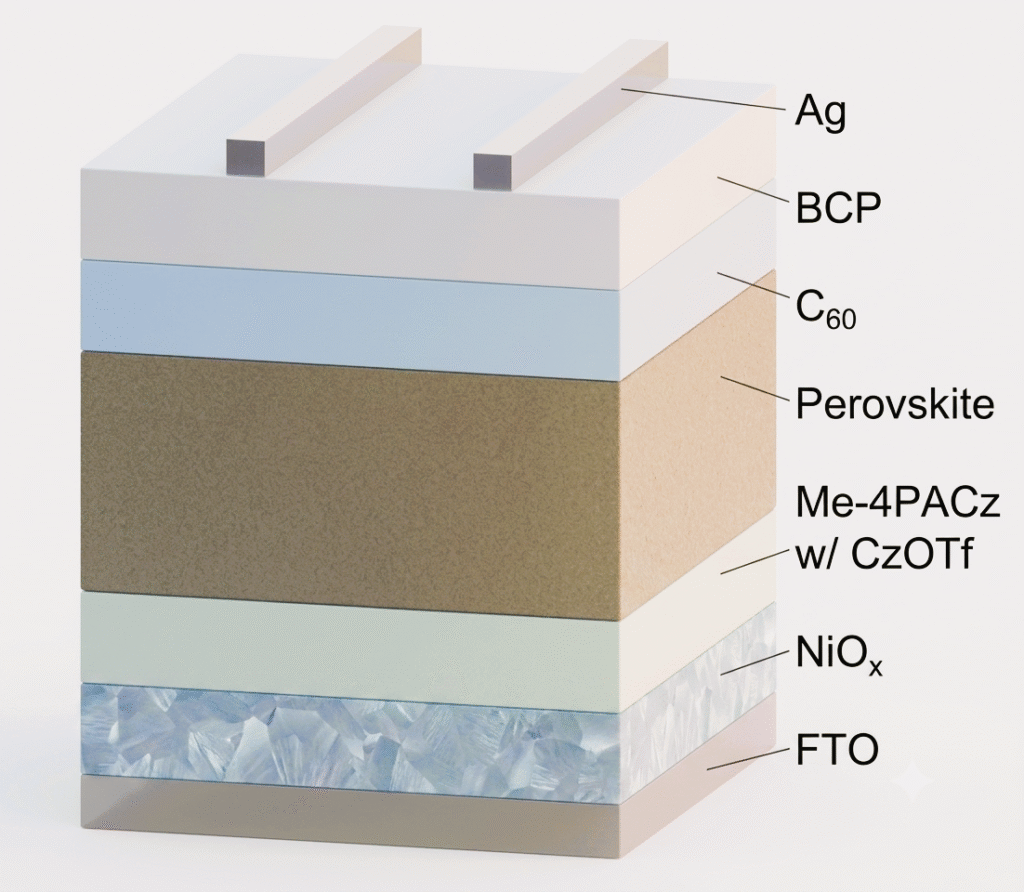
Inverted perovskite cells adopt a p-i-n device structure, where the hole-selective contact layer is located at the bottom of the intrinsic perovskite layer, with the electron transport layer on top; conventional halide perovskite cells use an n-i-p layout, with the order reversed. The researchers noted that the dual-molecule approach aims to suppress defects and chemical instability at the perovskite-transport layer interface by improving molecular order and passivation, while enhancing charge extraction and reducing non-radiative losses.
The research strategy involves adding 9H-carbazol-2-yl trifluoromethanesulfonate (CzOTf) to a hole transport layer made of the commonly used phosphonic acid (methyl-substituted carbazole, Me-4PACz). CzOTf does not replace the original hole transport layer but co-assembles with Me-4PACz at the interface between nickel oxide (NiOx) and the perovskite, integrating into the molecular monolayer structure. This addition achieves complementary functions: Me-4PACz maintains efficient hole-selective contact and anchors to NiOx, while CzOTf enhances molecular packing, increases surface coverage, and introduces additional chemical functionality through the sulfonate group. Together, they form a more uniform and strongly interacting interfacial layer, improving electronic coupling, defect passivation, and interfacial stability. Scanning electron microscopy (SEM) shows that the Me-4PACz-based control perovskite exhibits widespread pinhole defects and discontinuities at the bottom interface, while the CzOTf-modified film forms a denser, more compact, and pinhole-suppressed interfacial layer. The research team stated that CzOTf modification allows for the release of tensile stress in the perovskite film.
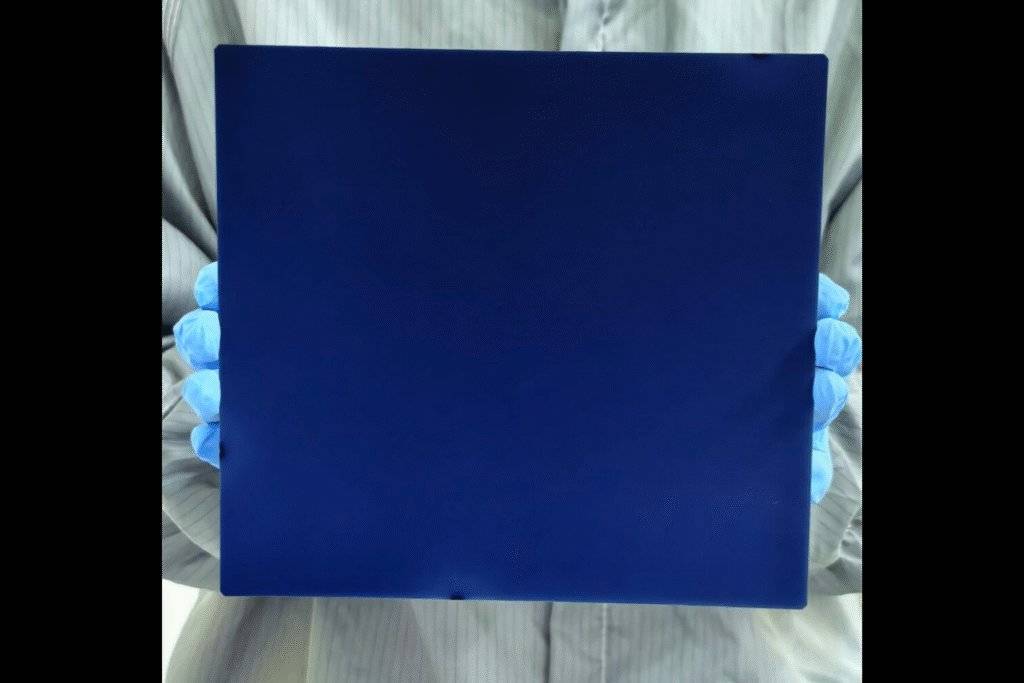
The device adopts a standard n-i-p inverted structure, based on a fluorine-doped tin oxide (FTO) transparent conductive substrate, coated with a NiOx hole transport layer, modified by the co-assembled Me-4PACz+CzOTf interfacial layer, followed by deposition of the perovskite absorber layer, a fullerene (C60) electron transport layer, a thin bathocuproine (BCP) buffer layer, and finally completed by thermal evaporation of a silver (Ag) back electrode. Tests show the cell achieves a power conversion efficiency of 27.3%, with an open-circuit voltage of 1.185 V, a short-circuit current density of 26.30 mA cm², and a fill factor of 87.64%. The reference device without the dual-molecule approach achieves an efficiency of 26.20%, with an open-circuit voltage of 1.172 V, a short-circuit current density of 26.05 mA cm², and a fill factor of 85.79%. When scaled up to an active area of 766 cm², the CzOTf-modified perovskite cell demonstrates a power conversion efficiency of 21.54%, an open-circuit voltage of 50.93 V, a short-circuit current of 0.4040 A, and a fill factor of 80.20%.
In terms of stability, the CzOTf-modified perovskite solar cell retains 92% of its initial efficiency after 2000 hours of continuous illumination. The CzOTf-modified large-area module operates stably outdoors for 35 days without degradation. A paper on this new cell architecture has been published in Science Advances, titled "Achieving 27.3% Perovskite Photovoltaic Devices via Interface-Locked Dual-Molecule Contact."