en.Wedoany.com Reported - On July 9, the core node of the National Supercomputing Internet was officially launched. This node can provide over 100,000 domestic AI computing cards externally, making it the largest single domestic AI computing resource pool connected to the National Supercomputing Internet platform since its launch. It supports scheduling at the 100,000-card level, full training of large models with trillion-level parameters, AI4S, and large-scale scientific engineering computations.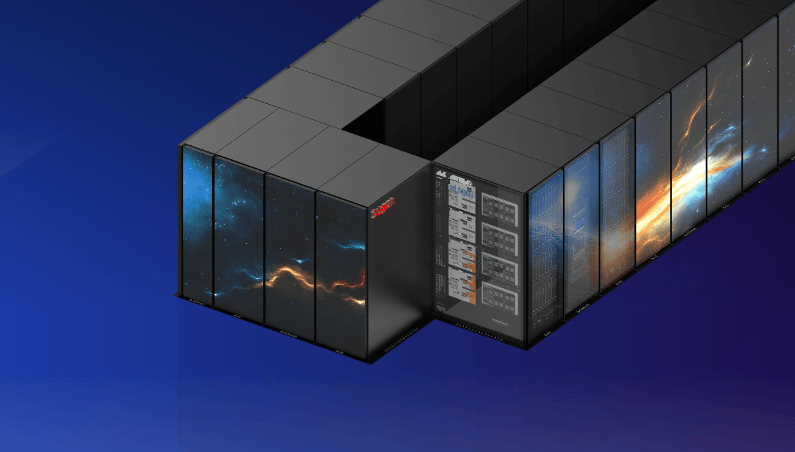
The core function of the National Supercomputing Internet core node is not just to centralize more computing equipment in one data center, but to integrate domestic AI computing power, supercomputing resources, industry models, scientific software, and scheduling platforms into a unified system. Large model training requires high-density accelerator cards, low-latency interconnects, high-throughput storage, and stable job management; AI4S needs to simultaneously handle high-precision scientific computing, low-precision intelligent computing, simulation data, experimental data, and model inference; large-scale scientific engineering computations also involve complex tasks such as fluid dynamics, materials science, quantum mechanics, meteorology, and industrial simulation. With the core node online, domestic AI computing power is no longer just a single-point supply but has entered a computing infrastructure that can be coordinated, scheduled, and serve multiple types of users.
During the trial operation, the core node completed over 70 tests at the 10,000-card scale.
Among them, 45,000 cards achieved DFT-precision simulation of 41.47 billion atoms, setting a new world record; the efficiency of billion-level grid simulations was improved from the weekly level to the hourly level, indicating that the node has entered the verification phase for scientific computing and engineering simulation, rather than remaining at the stage of equipment stacking or theoretical performance demonstration.
DFT-precision simulation imposes extremely high requirements on computational scale, memory access, task decomposition, and parallel efficiency. The scale of 41.47 billion atoms means the system must maintain stable scheduling and data exchange capabilities for ultra-large tasks. The efficiency improvement in billion-level grid simulations is closer to the needs of industrial engineering applications. Engineering simulations are often constrained by computation cycles, with complex models potentially requiring weeks to yield results; if efficiency is compressed to the hourly level, the pace of design iteration, parameter scanning, structural optimization, and risk verification will all change. The completion of these tests by the core node reflects its ability to form a collaborative capability among domestic accelerator cards, interconnection networks, storage systems, job scheduling, and scientific software adaptation.
Software ecosystem adaptation is also a key focus after the node's launch. The core node has deeply adapted over 400 industry large models and completed the domestic migration and optimization of professional software in key fields such as fluid dynamics, quantum mechanics, and simulation. For domestic computing power, hardware scale is only the first step; to truly enter scientific research, industrial, and enterprise applications, it is also necessary for models to run, software to migrate, tasks to be scheduled, data to be connected, and results to be reproducible. Industry large model adaptation addresses the AI application entry point, while the domestic migration of professional scientific software addresses the engineering computing entry point. Together, they determine whether domestic computing power can transition from "usable" to "easy to use."
The National Supercomputing Internet core node project undertakes comprehensive functions such as operation management, resource scheduling, supply-demand matching, and industry incubation. It is not aimed at a single research institution or a single enterprise but seeks to integrate computing supply and application demand nationwide, connecting scattered supercomputing, intelligent computing, and industry application resources into a unified scheduling system.
With the official launch of the over 100,000 domestic AI computing card resource pool, the core node's capabilities of the National Supercomputing Internet have moved from trial operation to the stage of large-scale service. Subsequent operational focus will be on the stability of 100,000-card-level task scheduling, training efficiency of trillion-parameter models, throughput of AI4S scientific research tasks, depth of professional software migration, number of connected industry large models, and cross-regional computing coordination capabilities.