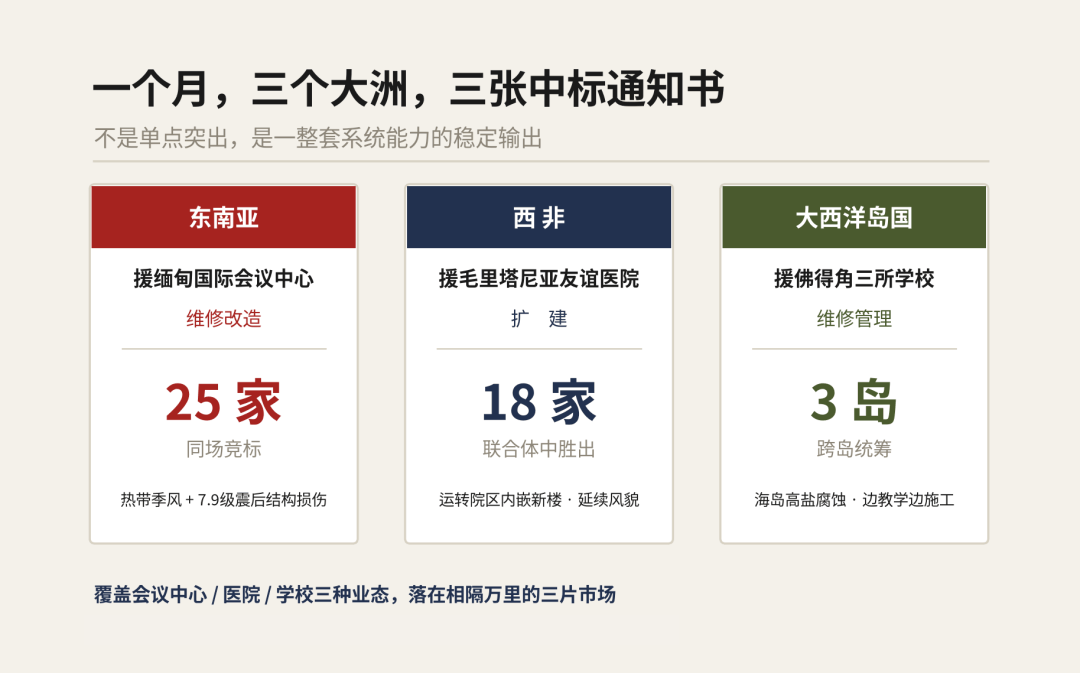
en.Wedoany.com Reported - China Aviation Planning and Design Institute (AVIC CAPDI) has won three consecutive foreign aid projects within the past month: the renovation of the Myanmar International Convention Center, the expansion of the Mauritania Friendship Hospital, and the repair of three schools in Cape Verde. These three projects are located in Southeast Asia, West Africa, and an Atlantic island nation, each with a different business type. Among them, the Mauritania project was selected from a consortium of 18 top Chinese design institutes, marking AVIC CAPDI's third aid project in Mauritania; the Myanmar project was won through competition against 25 other enterprises.
Bidding for foreign aid projects is highly competitive, often involving a dozen or even dozens of contenders for a single project. Winning three in such a short period demonstrates AVIC CAPDI's strength. These three bids fall under project management (package management), rather than pure construction general contracting. Like scheme design, they occupy the uppermost part of the value chain with the highest technical content, collectively referred to in the industry as high-end engineering services. High-end engineering services are precisely an area where Chinese enterprises going global have struggled to gain strength in the international market over the past decades.
Industry insiders generally believe that building more does not equate to reaching higher. Over decades of Chinese engineering going global, the achievements are evident. On the ENR "Top 250 International Contractors" list, 76 Chinese companies are listed, ranking first in number for many years, with total international revenue exceeding $127 billion, accounting for about a quarter (over 25%) of the top 250's total. However, on another ENR list, the "Top 225 International Design Firms," only 21 Chinese mainland firms are listed, with international revenue accounting for only about 7% of the top 225's total. While the contracting segment accounts for nearly a quarter, the high-end service segment holds only a single-digit share. This high ground remains largely in the hands of European and American companies. The top ten of the design 225 are almost entirely dominated by established engineering consultants such as WSP, AECOM, Jacobs, Arcadis, and Fluor. Most Chinese firms on the list are comprehensive engineering group giants like PowerChina, Energy China, and CCCC, which drive design volume through general contracting; truly independent design consulting enterprises have overseas revenues mostly in the range of tens of millions to one hundred million US dollars.
A Ministry of Commerce report described it as: Chinese construction industry going global, "the body has gone out, but the head has not." This "head" refers to the uppermost part of the value chain: planning, design, consulting, and high-end project management. It determines how a project is defined, what standards are used, and whose rules are followed. Without securing this segment, companies are confined to mid-stream construction work, with thin profit margins and little say, while the design and supervision of high-end projects still require European and American firms, squeezing their own space. Chinese enterprises now seek quality over quantity. In the international market, most Chinese companies concentrate on the construction segment, while the stages that determine project direction—from schemes and standards to high-end project management—are often controlled by European and American firms.
The three projects won by AVIC CAPDI fall under project management, which is part of high-end services. Against the industry's general focus on construction, AVIC CAPDI's sustained efforts in this area merit attention to its foundational conditions. In recent years, both at the national and enterprise levels in China, there has been a push to extend to the high end of the industrial chain. Ministries such as the Ministry of Commerce and the National Development and Reform Commission have issued documents encouraging design consulting to "go global," promoting whole-process engineering consulting, and shifting from "construction and installation" to comprehensive capabilities of "investment and financing + construction + operation." On the enterprise side, some fill gaps through mergers and acquisitions, others move upward via "design-led EPC," and some adopt whole-process consulting and integrated investment-construction-operation as new strategies.
AVIC CAPDI, originating from the aviation industry in 1951, is still engaged in aircraft engineering and aero-engine engineering. The stringent requirements of aviation for precision, safety, and system integration endow it with unique capabilities in complex structures, electromechanics, large spans, and extreme conditions. It holds comprehensive qualifications, possessing the highest-level certifications in investment, consulting, survey, design, supervision, and cost estimation. In 2007, it became the first in China to receive the Comprehensive Class A Engineering Design qualification, with rights for foreign operations and foreign contracting. Its capabilities are integrated, not limited to "drawing," but linking investment, planning, design, construction, and operation into a chain, positioning itself as a "world-class value integrator in the engineering field." It has a strong foundation, with 11 national survey and design masters, over 3,500 professionals, and overseas projects in more than 30 countries, such as the Xai-Xai Airport in Mozambique and the National Stadium in El Salvador, while also exporting Chinese standards. AVIC CAPDI is one of the promising representatives of China's high-end engineering services breaking through upward.
For an institute with such a foundation to develop high-end engineering services, multifaceted support is needed: talent with knowledge of international standards and cross-cultural skills; market reputation requires long-term cultivation; mechanisms need to align with international practices in organization and incentives; and the group must provide support in funding, branding, and the industrial chain. For foreign contracting enterprises, three types of companies should particularly pay attention to upstream institutes like AVIC CAPDI: first, construction contractors needing scheme and technical partners for high-end projects; second, enterprises aiming to upgrade to integrated investment-construction-operation; and third, companies entering fields with high technical thresholds. Such collaboration helps win projects and execute them well.