en.Wedoany.com Reported - Peregrine Gold (ASX: PGD) has submitted a mining lease application for its Capricorn prospect at the Newman Project in Western Australia. The company previously discovered gold traces in an ancient gravel layer stretching up to 4 kilometers, with the new application covering an area of 202 hectares.
The Capricorn prospect is located south of the Peninsula prospect, and sampling has confirmed the presence of gold in the ancient gravel layer. This gold-bearing ancient gravel layer has been mapped over a length of 3 to 4 kilometers. The mining lease application is adjacent to a special prospecting license application area secured by renowned prospector and major shareholder Mark Creasy.
Peregrine Gold Technical Director George Merhi stated that this discovery highlights a potentially significant near-surface mineralized zone, which, if confirmed by further testing, could provide a low-cost pathway for early gold mining. He noted that submitting the mining lease application secures the tenure for this target, enabling the company to rapidly assess small-scale mining opportunities while awaiting the imminent approval of the special prospecting license for the Peninsula prospect.
The company theorizes that such a prominent shallow gold zone is likely fed by a larger bedrock source, which could lead to a major commercial discovery. The spatial dispersion of such a large-scale gold anomaly in gravel without an adjacent bedrock source is considered highly unusual.
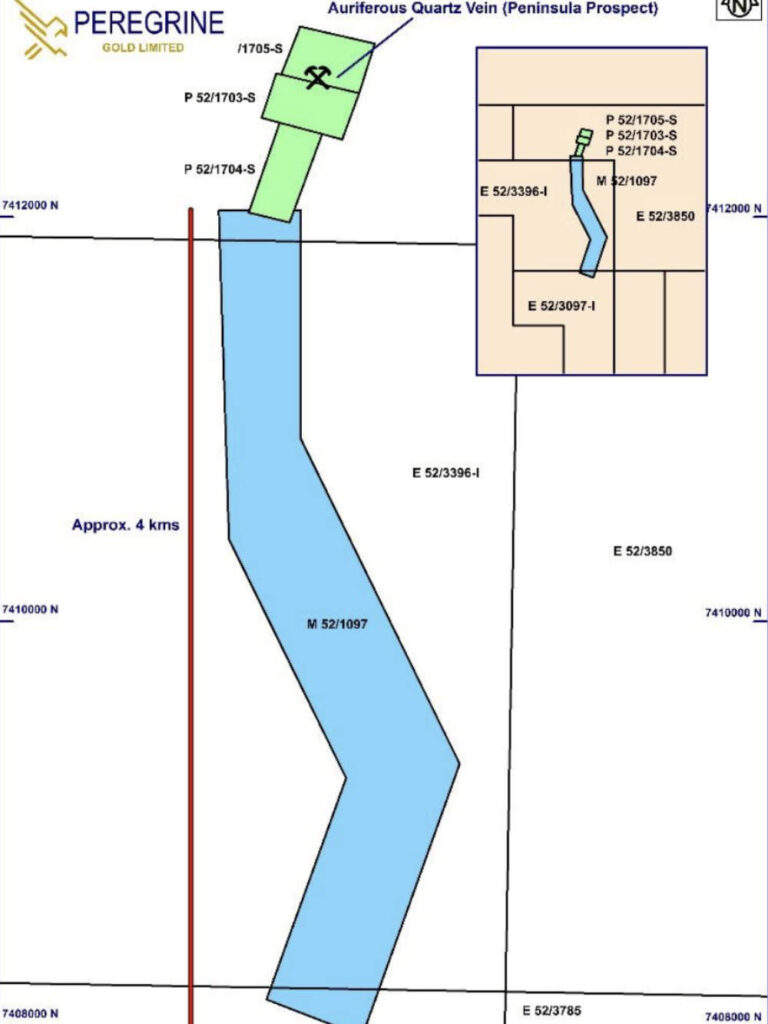
PGD first noted the potential of the Capricorn prospect when gold particles were discovered during targeted bulk sampling of a previously mapped gold-bearing quartz vein south of Peninsula. Subsequently, the company conducted a comprehensive geochemical sampling program on the ancient gravel layer, simulating a traditional stream sampling approach. Sampling focused on the main creek floodplain, which flows north to south through the Peninsula prospect. Mapping indicates that the ancient gravel system ranges in width from 43 meters to 185 meters, with an average thickness of approximately 1 meter. Although further assay results are pending, the existing results were sufficient to prompt the company to apply for this mining lease, which meets the requirements for a mining development and closure proposal for small-scale mining operations.
The company will next receive and interpret the remaining geochemical samples and conduct additional bulk sampling to assess gold grades, as both fine and coarse gold particles are present in the panned concentrates. PGD will also evaluate dry blowing as a potential processing technology. Company geologists are designing a dual-track "mining and exploration" plan to maximize the potential returns from gold-bearing gravels and obtain geological information on the potential bedrock source.