en.Wedoany.com Reported - The China Geological Survey recently showcased a batch of self-developed geological exploration equipment, which was unveiled during the National Geological Exploration Industry Management Work Seminar, reflecting the agency's progress in equipment development in recent years.
Since the implementation of the new round of strategic mineral exploration breakthrough initiative, the Office of the New Round of Strategic Mineral Exploration Breakthrough Initiative under the Ministry of Natural Resources has vigorously promoted the development of green exploration equipment. It issued the "Guiding Opinions on Strengthening Equipment Development for the New Round of Strategic Mineral Exploration Breakthrough Initiative" and released the first batch of the "Four Batches" exploration equipment development list. In 2026, the China Geological Survey systematically reviewed its self-developed equipment and published the "Self-Developed Equipment Promotion List (First Batch)." This exhibition marks the transition of this list from paper to physical display and promotion.
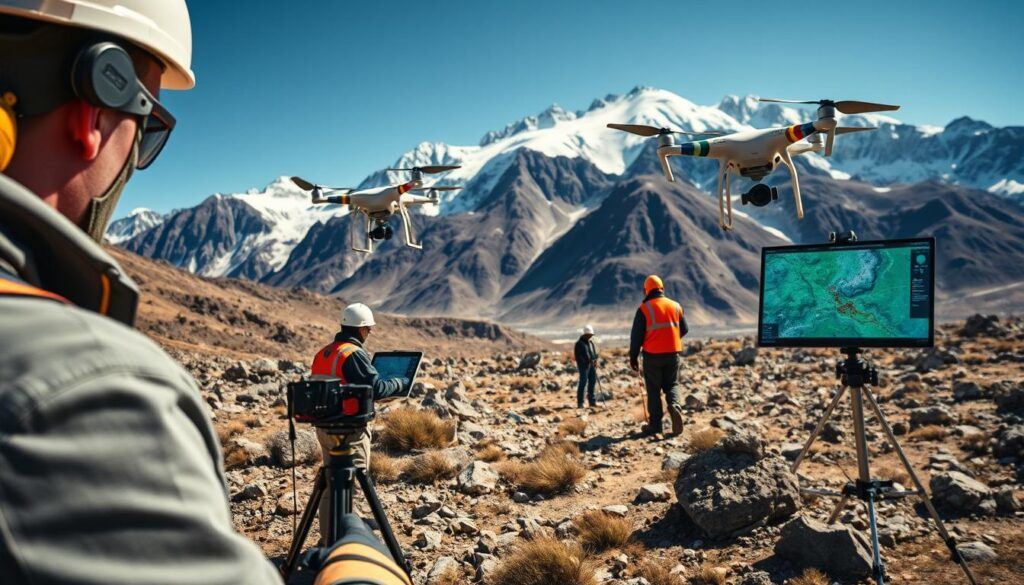
The exhibited equipment covers multiple fields, from Earth observation to borehole detection. The miniaturized aeromagnetic survey system developed by the China Aero Geophysical Survey and Remote Sensing Center for Natural Resources can be flexibly adapted to various drone platforms, enabling high-precision measurements in areas difficult for personnel to access, such as plateaus, alpine permafrost, and desert gobi. The accompanying small lightweight airborne gravimeter, weighing no more than 40 kilograms, fills a domestic gap in lightweight airborne gravity measurement equipment and has been deployed for terrain-following measurements in high-altitude, deeply incised areas. According to experts, this device has reached or even led the world's top level in this field.
The ground-air transient electromagnetic system developed by the Institute of Geophysical and Geochemical Exploration, Chinese Academy of Geological Sciences, was a highlight of the exhibition. This system adopts an innovative model of ground-based transmission and drone-based aerial reception, significantly enhancing detection depth, accuracy, and efficiency, and enabling direct detection of blind ore bodies near boreholes. Also on display was the distributed multi-parameter electromagnetic detection system, which extends the detection depth of controlled-source electromagnetic methods from the traditional 1,500 meters to 5,000 meters, with strong anti-interference capabilities, playing a vital role in surveys of metallic minerals, clean energy, and oil and gas exploration.
In terms of digital equipment, the fully automated digital core comprehensive scanner from the Nanjing Geological Survey Center of the China Geological Survey enables integrated data collection of core images, alteration mineral spectra, and elemental content without damaging the core, attracting attention from multiple geological exploration units and mining enterprises. The portable core image scanner from the National Geological Material Data Center allows for one-click digital archiving of cores through high-precision digital scanning. The deep-penetrating ground-penetrating radar series from the Chinese Academy of Geological Sciences offers meter-level and centimeter-level precision, enabling rapid 3D imaging with low energy consumption and minimal damage to surrounding farmland and natural environments.
The "Smart Magnetic" drilling target guidance system, developed by the Institute of Exploration Techniques, Chinese Academy of Geological Sciences, has been in use for nearly 20 years and has been upgraded to its fourth generation. From breaking foreign technological blockades to ongoing technological iteration and scenario expansion, the system's journey epitomizes the self-reliance of China's geological exploration equipment. On-site technicians noted that many core technologies were previously imported, but now an increasing number of key equipment are independently controllable, providing the geological exploration industry with a solid foundation.
The concept of green exploration has transitioned from theory to specific technical parameters. The Beijing Institute of Exploration Engineering brought the daily reality of green drilling to the exhibition: in a mining area within the southwestern mountains, an electric drilling rig operates efficiently, while waste mud treatment equipment degrades and recycles materials, with no visible liquid spillage on the ground; drillers no longer need to mix on-site, as clear, environmentally friendly flushing fluid is pre-loaded in mud tanks; at the bottom of the borehole, an ultra-high matrix long-life core bit rotates, reducing the number of trips and thus minimizing surface disturbance. Modular drilling rigs were a highlight; in complex terrains like deep mountains and dense forests, the rig can be disassembled into several modules, transported by manpower or small vehicles, and reassembled on-site, avoiding the ecological damage caused by traditional road construction. The 4,000-meter permanent magnet direct-drive electric rig, powered by rare-earth permanent magnet motors, saves 20% to 30% energy compared to traditional electric rigs. On-site technicians stated that for drilling, green is not just a concept but is implemented in every technical parameter.
The distributed fiber optic monitoring technology equipment from the Center for Hydrogeology and Environmental Geology, China Geological Survey, embodies another form of green intelligence. This device leverages fiber optic sensing characteristics to obtain a complete temperature profile of the entire well in a single measurement; the weak grating terrain deformation monitoring system can monitor land subsidence in layers. Previously, tasks requiring multiple wells for bedrock markers and layered marker groups can now be accomplished with a single well, significantly reducing construction costs and minimizing impacts on land and groundwater environments. Also on display was the intelligent surface crack monitor, which can be fully powered by solar energy, is easy to deploy in the field, operates with zero carbon emissions, and can run unattended.
Beyond individual equipment innovations, the China Geological Survey has established a green exploration equipment system centered on "three major innovation centers and four typical scenarios." The Aero Geophysical Exploration and Remote Sensing Innovation Center, based at the Aero Geophysical Survey and Remote Sensing Center, focuses on the "satellite-air" platform; the Ground Geophysics, Geochemistry, and Analytical Testing Innovation Center, based at the Chinese Academy of Geological Sciences, focuses on the "ground" platform; and the Geological Drilling Innovation Center, based at the Institute of Exploration Techniques, Chinese Academy of Geological Sciences, focuses on the "borehole" platform. These three centers, together with multiple co-building units, form an integrated "industry-academia-research-application" collaborative innovation framework.
This equipment exhibition simultaneously presented green exploration equipment systems for four typical scenarios: desert gobi, forest coverage, grassland wetlands, and intertidal mudflats. The desert gobi demonstration is set in the East Tianshan-Beishan metallogenic belt, centered on a full "satellite-air-ground-borehole" chain; the forest coverage area focuses on the Jiapigou-Haigou gold deposit in Jilin, featuring lightweight transportation and multi-branch drilling technology; the grassland wetland area is deployed in the Xilinhot-Dong Ujimqin Banner metallogenic belt in Inner Mongolia, emphasizing intelligent detection and modular drilling rig operations; the intertidal mudflat area is near Wenchang, Hainan, addressing challenges of "inaccessibility, instability, and shallow drilling" by integrating amphibious multi-functional drilling platforms, seabed drilling rigs, and autonomous underwater vehicles to build a cross-media geological exploration system.
Currently, China is accelerating the self-development and green transformation of exploration equipment, with a batch of green and intelligent exploration tools already in application. This equipment exhibition not only showcases phased achievements but also serves as a technical briefing for the demand side, providing equipment support for the new round of strategic mineral exploration breakthrough initiative.