en.Wedoany.com Reported - Researchers from the University of Nottingham and the University of California, Berkeley have developed a new resin chemical system that suppresses overheating issues in the Computed Axial Lithography (CAL) volumetric additive manufacturing process, which can cause part warping and fusion.
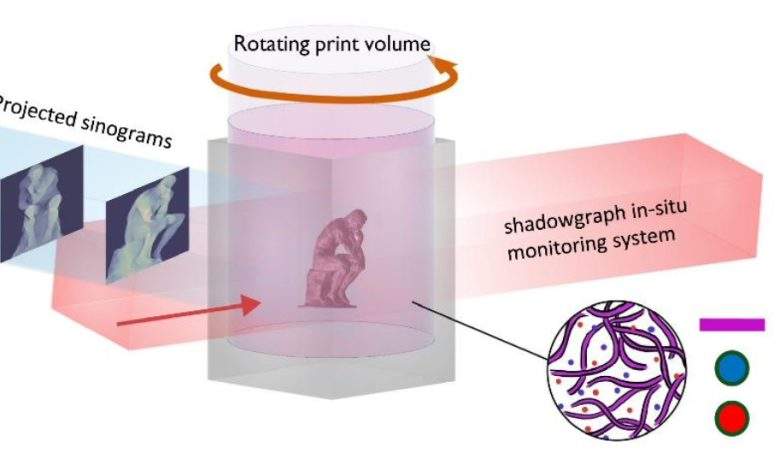
The CAL process cures an entire 3D object at once by projecting light into a rotating resin vat. This technology relies on free radical polymerization (FRP) to build parts, but once triggered, the reaction rapidly releases heat, inducing the Trommsdorff effect (gel effect). This self-reinforcing cycle causes resin in hotter regions to cure faster and release more heat, thereby distorting or fusing structural features that should remain separate. Research published in Nature Communications shows that introducing reversible addition-fragmentation chain transfer (RAFT) polymerization into common CAL resins significantly reduces exothermic runaway, a phenomenon that previously limited the precision and scalability of this technology.
The research team tested a common CAL resin, pentaerythritol tetraacrylate, and found that prints without RAFT agents experienced a temperature rise of 59 degrees Celsius during polymerization. After adding a dithiobenzoate-type RAFT agent called CPBD, the temperature rise dropped to 27°C at a 0.1% addition level and further decreased to 3.5°C at a 0.3% addition level. Thermal imaging and shadowgraphy results showed that resin without RAFT agents exhibited over-curing within minutes, while resin containing 0.2% RAFT agent showed no over-curing even two minutes after object formation.
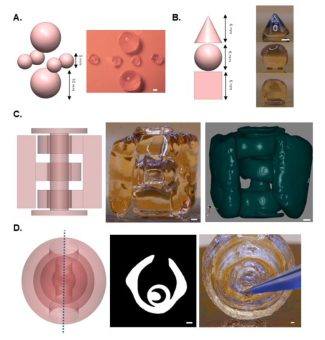
The chemical system also addresses thermal buoyancy—a defect caused by heat-driven convection that shifts parts during printing. When printing a test object consisting of three spheres of different sizes using standard FRP resin, the spheres fused into a single mass; using the RAFT formulation, they formed as separate, correctly spaced parts with a feature resolution of 150 micrometers. The study authors also printed nested and interlocking geometries and utilized the active end groups retained by the RAFT agent to graft additional polymer coatings onto the finished parts after printing. The research team stated that this step could support future multi-material manufacturing.