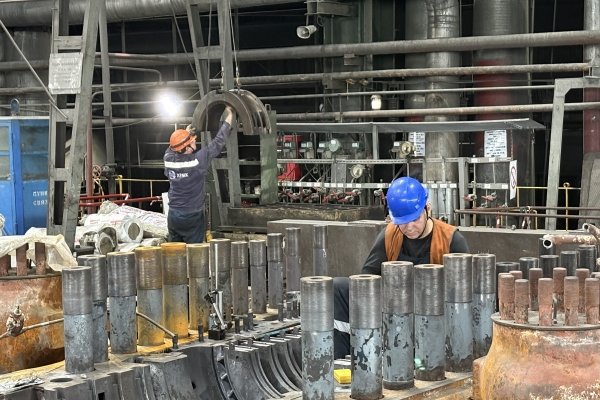
en.Wedoany.com Reported - Centrus Energy has signed a contract finalizing the terms of a $900 million competitive task order awarded earlier this year by the U.S. Department of Energy (DOE) to support the deployment of high-assay low-enriched uranium (HALEU) production at a commercial scale. This marks the transition of its facility in Piqua, Ohio, from a government-supported technology demonstration phase to long-term commercial-scale production, as part of the company's multi-billion-dollar capacity expansion plan covering both low-enriched uranium (LEU) and HALEU.
Centrus President and CEO Amir Vexler stated that this announcement is another milestone in the company's expansion, as it transitions from a technology demonstration contract to a new, large-scale contract aimed at commercial production. He noted that the government's investment through this contract will be matched multiple times by billions of dollars in capital, including other non-dilutive, non-debt financing and customer contracts, to restore the United States' large-scale uranium enrichment capabilities.
Centrus won a contract in 2019 to build a series of advanced centrifuges in Piqua to demonstrate HALEU production using U.S. technology. In 2022, the contract was modified and extended to allow for longer-term HALEU production. The contract progresses in three phases: Phase 1 (end of 2023) involved starting the HALEU centrifuge cascade and delivering HALEU to the DOE; Phase 2 (targeted for June 30, 2025) requires deployment and initial production scale-up, achieving a baseline milestone of 900 kilograms of HALEU; upon successful completion of Phase 2, the DOE exercises its discretionary option (Phase 3) to fund a one-year extension, pushing the operational window to June 30, 2026.
With the final batch of 900 kilograms completed two weeks early in mid-June, all production under the 2022 framework has concluded, with cumulative output exceeding 1,900 kilograms over the contract period. Centrus and the DOE have signed a three-month, $15 million HALEU storage extension contract. As large-scale expansion progresses, Centrus is transitioning from the old demonstration contract to commercialization, moving toward newer, larger enrichment contracts. The first new capacity is expected to come online in 2029. In the interim, Centrus plans to privately operate the existing HALEU cascade on a commercial basis to meet near-term customer demand and is working with the DOE on related agreements to facilitate this transition, including extending the long-term lease for the American Centrifuge Plant in Piqua, Ohio.
The new fixed-price HALEU enrichment contract requires Centrus to deploy commercial-scale HALEU production capacity in Piqua. The contract also includes discretionary options for the DOE to procure up to $170 million worth of HALEU for departmental missions. The total value of the contract, including all options, is $1.07 billion. Initial construction will include HALEU production capacity of 12 tons per year, along with the capability to meet Centrus's existing $2.4 billion LEU backlog.
Centrus has initiated domestic centrifuge manufacturing at its facility in Oak Ridge, Tennessee, to support the Piqua expansion. The project is expected to support thousands of jobs, including 1,000 construction jobs in Ohio and 300 new operational positions, while retaining the existing 150 jobs at the Piqua facility. The expansion is backed by public and private funding as well as commercial contracts, with a framework encompassing national security missions, third-party investments, LEU and HALEU commercial contracts, and Centrus's capital position.
Centrus's facility in Piqua, Ohio, is located on a historically strategic site that has been a pillar of U.S. nuclear infrastructure for over 70 years. The site, officially known as the American Centrifuge Plant (ACP), is co-located with the Portsmouth Gaseous Diffusion Plant reservation. The U.S. Atomic Energy Commission selected this 3,700-acre site in August 1952 to expand U.S. nuclear capabilities. The facility began operations in 1954, initially producing weapons-grade uranium for defense and naval nuclear propulsion. In the late 20th century, the site shifted to non-military assets, producing LEU for commercial nuclear power plants. The original gaseous diffusion plant officially ceased operations in May 2001 and was returned to the DOE for decontamination and decommissioning.
Centrus's predecessor, the United States Enrichment Corporation (USEC), was established under the Energy Policy Act of 1992 to take over government enrichment facilities and drive privatization. In 1998, the government fully privatized the entity through an initial public offering (IPO). Following the Fukushima nuclear disaster in Japan in 2011, global nuclear fuel demand plummeted, and uranium prices collapsed, severely limiting USEC's operating revenue. USEC invested billions of dollars in an attempt to build a modern centrifuge plant but failed to secure federal loan guarantees to complete the project. In March 2014, burdened with $1.07 billion in debt, USEC filed for Chapter 11 bankruptcy protection to restructure its balance sheet. In September 2014, the company emerged from bankruptcy, renamed Centrus Energy Corp., allowing it to shed costly legacy liabilities, pivot to a technology and services model, and lay the groundwork for winning the HALEU demonstration contracts that now fund its operations.