UK's euNetworks Launches 1,057 km Fiber Trunk Route from Paris, France to Milan, Italy
en.Wedoany.com Reported - Recently, UK-based bandwidth infrastructure operator euNetworks announced the completion and market delivery of a new long-haul fiber trunk route connecting Paris, France to Milan, Italy. Spanning 1,057 kilometers, this route takes a new path through the Alps, adding a shorter and directionally distinct backbone transmission channel between two major European communication hubs. The UK euNetworks Group is registered and headquartered in London, UK.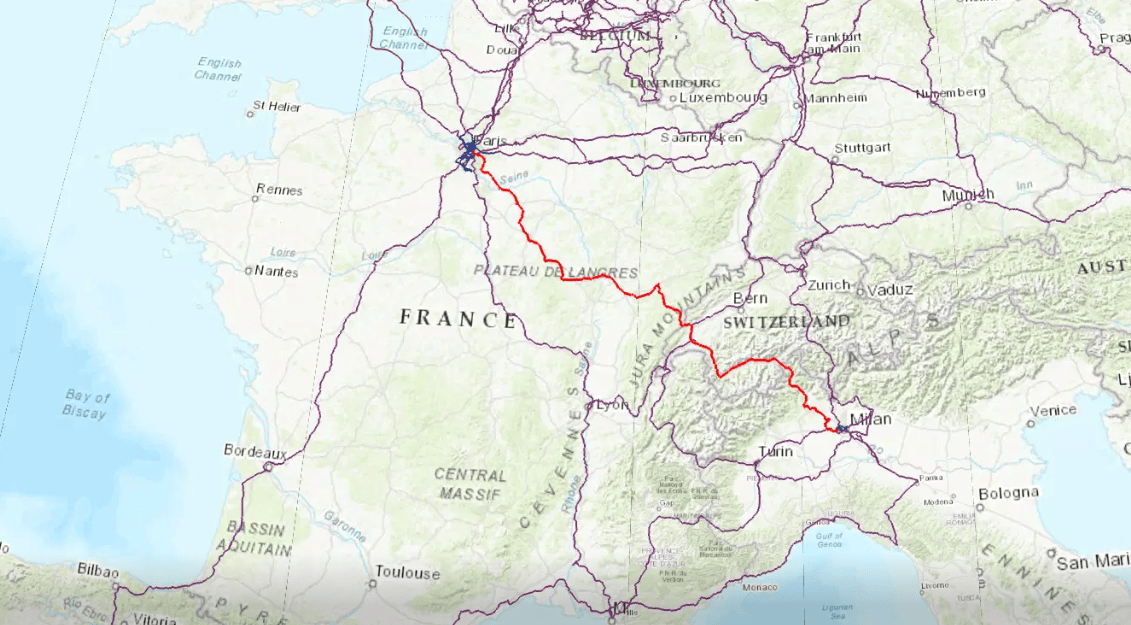
The new route does not follow the more common southern coastal path between Paris and Milan. Existing networks often pass through Lyon and Marseille in France before entering Italy, whereas this newly delivered fiber trunk directly crosses the Alps, offering a new directional option. For communication operators, cloud service providers, and data center clients requiring large-scale data transmission between the two cities, this new route reduces reliance on existing coastal corridors.
UK euNetworks positions this route as a long-haul communication infrastructure with route diversity. Here, "route diversity" does not simply mean adding more fiber within the same corridor, but organizing the backbone network through different geographical directions. When certain lines cannot carry traffic due to construction, equipment maintenance, or other reasons, clients can configure alternative transmission paths based on their network architecture, enhancing the redundancy of cross-border communication networks. The company did not disclose the specific investment amount, fiber count, designed transmission capacity, or construction contractor for this project.
On the Paris end, the new route can connect to euNetworks' self-built and operated metropolitan fiber network, which already links 38 local data centers. On the Milan end, it can connect to a metropolitan network covering 18 data centers. Clients can also extend connectivity to over 600 data centers across Europe through the company's existing European backbone network. This means the delivery is not just a fiber segment between two cities, but the integration of a new trans-Alpine trunk into multiple metropolitan networks and data center interconnection nodes.
UK euNetworks currently operates 18 metropolitan networks, with its high-capacity intercity backbone covering 53 cities across 17 European countries. With the addition of this new Paris-Milan route, traffic at both ends can be further extended to other European cities, supporting data center interconnection, cloud platform access, operator backbone transmission, and enterprise private line communication needs. The company's existing infrastructure services are primarily built on dark fiber, wavelength, Ethernet, and internet transmission networks.
This project also connects with euNetworks' previously delivered Germany Frankfurt-Zurich, Switzerland-Milan, Italy route. The latter was put into service in October 2025, and the newly built Paris-Milan route further increases path options between communication nodes in Western, Central, and Southern Europe, enabling relevant clients to organize cross-border networks based on transmission distance, data center locations, and backup requirements.
Unlike communication projects still in planning, permitting, or financing stages, this 1,057 km long-haul fiber trunk has already been delivered. UK euNetworks stated that building a differentiated route through the Alps requires coordinated implementation with a broad supplier network, but the announcement did not disclose specific suppliers for fiber optic cable manufacturing, pipeline construction, optical transmission equipment, or line testing. Subsequent market progress will primarily focus on client access, capacity activation, and interconnection of this route with other European backbone networks.
As data exchange volumes between European data centers increase, communication infrastructure construction is shifting from simply expanding bandwidth to simultaneously considering transmission distance, cross-border routing, and backup paths. Paris and Milan are both cities with concentrated data centers and network connections in Europe. This new trans-Alpine trunk provides a communication channel distinct from the traditional coastal corridor between the two cities, directly connecting to a total of 56 data centers across both cities.
Related Products


Mine Explosion-proof and Intrinsically Safe Industrial Ethernet Ring Network (10 Gigabit/Gigabit)
Chongqing Mas Sci&Tech Co., Ltd.
20 Inch 1600*900 Full HD 60Hz TFT LED Monitor with VGA and DP Interfaces for Desktop Computers-Business Use
Guangzhou Zanying Optoelectronics Technology Co., Ltd.
Conveyor Belt Intelligent Monitoring System
LUO YANG WIRE ROPE INSPECTION TECHNOLOGY CO., LTD.


Hot Selling 10 Inch Intel N5100 I5 I7 FHD 8 +128GB 16+256GB Win10 Pro Win11 Pro 4G 5G Rugged Tablet PC Pad with NFC Barcode
Highton Electronics Co., Ltd.
One-Stop Steward Service for the Entire Logistics System Integration Chain
Zhongding Intelligent (Wuxi) Technology Co., Ltd.


Automatic Aiming Laser Remote Obstacle Removal Robot
Pinggao Group Weihai High-Voltage Apparatus Co., Ltd.