en.Wedoany.com Reported - The European SEA-LIFT floating wind project has entered the experimental validation phase, with its innovative jack-up system now being integrated onto the first scaled floating platform. Experimental tests to verify system integration have commenced at the Cantabria Coastal Ocean Basin (CCOB). IHCantabria stated that this milestone marks the beginning of the project's experimental phase, during which the technology's performance will be evaluated under operating conditions representative of the marine environment.
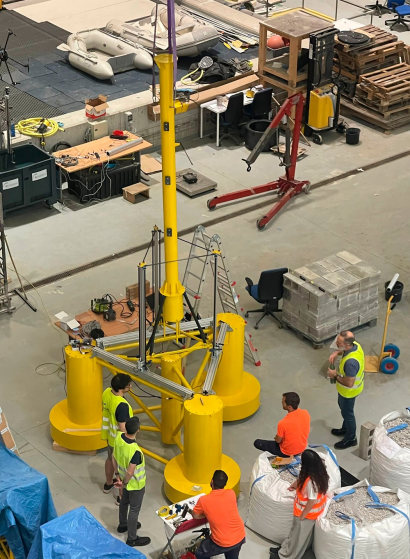
The platform, built at a 1:30 scale, replicates the floating offshore wind platform concept designed by IHCantabria for 10-megawatt (MW) turbines under the TRL+ project (Retos-Colaboración 2015). The IHCantabria team, in collaboration with Cener, has integrated the lifting system developed by NabraWind onto this platform. The system consists of three horizontal brackets installed on the platform's pontoons, a tower lifting tripod, and three guide columns, enabling a controlled, safe, and efficient lifting process.
Personnel from the National Renewable Energy Centre (Centro Nacional de Energías Renovables, Cener), responsible for developing the SEA-LIFT control system, have traveled to IHCantabria's facilities to perform initial tasks for system integration and commissioning. They inspected the operation of the mechanisms comprising the controller, the integration of motors on the scaled platform, communication tests between equipment, and preliminary validation of each subsystem.
IHCantabria indicated that these activities validate the coordinated operation of technologies developed by the various SEA-LIFT project partners and confirm the correct integration of all project technical developments. Following the completion of system integration on the first scaled platform, new dry validation tests will be conducted to verify overall functionality. Subsequently, the project will proceed to integrate the system onto a second scaled platform, corresponding to the SATH technology developed by Saitec. After this phase, experimental activities will begin at IHCantabria's Coastal Ocean Basin (CCOB), experimentally evaluating the SEA-LIFT system's performance on both platform configurations under conditions representative of the marine environment.
According to IHCantabria, the objective is to validate the technology across different floating platform concepts and demonstrate its feasibility as a solution for offshore wind turbine installation and maintenance operations. This project phase also requires close coordination among the participating disciplines and entities, thereby strengthening technology integration, knowledge transfer, and collaborative work within the consortium.
The SEA-LIFT project aims to develop an innovative solution for installation and maintenance operations of offshore wind farms. This technology will enhance the availability of installation equipment, provide greater flexibility in project planning and execution, and reduce reliance on large crane vessels and highly specialized port infrastructure. The project consortium estimates that SEA-LIFT could reduce the costs associated with such operations by three to five times compared to traditional methods. Its jack-up concept will minimize the need for large port infrastructure, enabling ports that currently lack these capabilities to participate in the deployment of floating offshore wind.
Against the backdrop of continuously increasing turbine sizes and ambitious offshore wind capacity targets for 2030 and 2050, SEA-LIFT is expected to provide a more efficient, flexible, and competitive solution for the installation and operation of offshore wind farms. The SEA-LIFT project partners include Nabrawind, Saitec, Tetrace, Ingecid, CENER, and IHCantabria. This project (PLEC2023-010279) is funded by the Spanish Ministry of Science, Innovation and Universities (Ministerio de Ciencia, Innovación y Universidades), the European Innovation Agency (MICIU/AEI /10.13039/501100011033), and subsidized by the Centre for Technological Development and Innovation (Centro para el Desarrollo Tecnológico y la Innovación, CDTI).