UAE's Hope Probe Mars Mission Extended to 2028
en.Wedoany.com Reported - The Hope Probe continues to achieve scientific discoveries, and the UAE has extended its Mars exploration mission to 2028 to continue collecting Martian climate and atmospheric data.
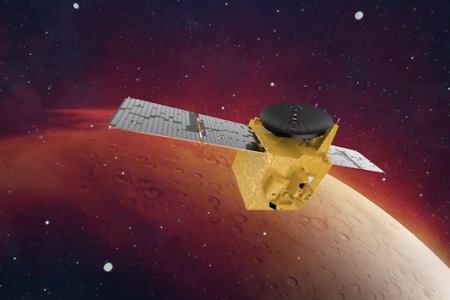
Launched in July 2020, the probe entered Mars orbit on February 9, 2021, becoming the first Arab and Islamic mission to explore another planet. This achievement made the UAE the fifth country in history to reach Mars orbit and the first to succeed on its initial attempt.
The mission employs a unique elliptical orbit (ranging from approximately 20,000 km to 43,000 km above the Martian surface). This orbit enables continuous observations throughout the Martian day and across all seasons, linking lower atmospheric processes with upper atmospheric processes, including energy and gas movements as well as atmospheric escape mechanisms.
The probe carries three scientific instruments: the Emirates Exploration Imager (EXI) for high-resolution imaging; the Emirates Mars Infrared Spectrometer (EMIRS) to measure atmospheric temperatures and map the distribution of dust, water vapor, and ice crystals; and the Emirates Mars Ultraviolet Spectrometer (EMUS) to observe the upper atmosphere and track the escape of hydrogen and oxygen.
Since entering orbit, the probe has collected and publicly shared over 10 terabytes of scientific data, releasing 16 batches of data. More than 200 international research institutions and universities have benefited from these datasets. Related findings have been published in over 35 peer-reviewed papers in international journals, and the mission team has delivered over 250 scientific presentations at conferences.
Through collaborations with UAE University and New York University Abu Dhabi, the mission integrates probe data into research projects, supporting national capacity building and enhancing expertise in space and planetary sciences.
The Hope Probe has achieved a series of scientific discoveries, including previously unknown forms of Martian auroras, such as winding discrete auroras and patchy proton auroras, providing new insights into the interactions between the Martian atmosphere, solar wind, and magnetic field environment. The probe also captured high-resolution data of Mars' smaller moon, Deimos, offering the first comprehensive close-up observations. Additionally, the probe observed the interstellar comet 3I/ATLAS using the Emirates Exploration Imager and the Emirates Mars Ultraviolet Spectrometer, providing an opportunity to study material from another star system.
In February 2026, the UAE Space Agency announced a three-year mission extension to 2028. The extension will allow the probe to continue collecting Martian climate data, monitor seasonal changes, and provide opportunities for the UAE national team to enhance operational expertise, preparing for the Emirates Mission to the Asteroid Belt (EMA), scheduled for launch in 2028.
Related Products