SHINING 3D Launches EinScan Trak Wireless Optical Tracking System
en.Wedoany.com Reported - SHINING 3D has launched the EinScan Trak wireless optical tracking system, built around a detachable handheld laser scanner and positioned as the first wireless, dual-mode, marker-free tracking system, suitable for applications such as reverse engineering, automotive customization, cultural heritage preservation, and digitization of large objects.
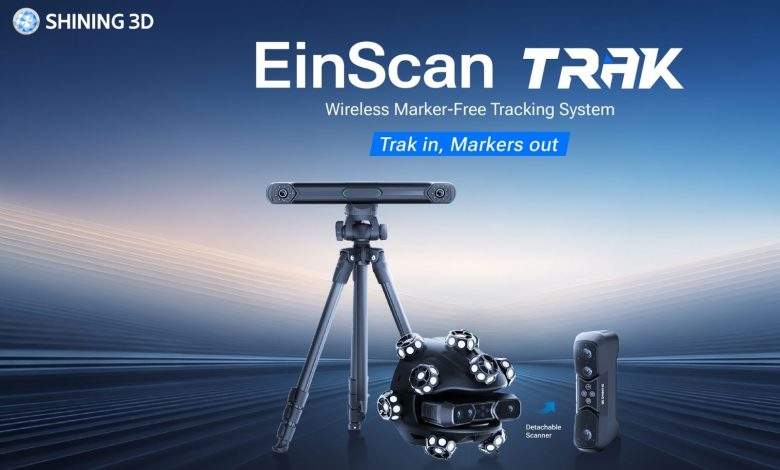
In tracking mode, the spherical scanner and a standalone tracker work together wirelessly, with retro-reflective markers placed on the scanner body rather than on the surface of the measured object. According to SHINING 3D, this design allows operators to scan medium-to-large objects such as car bodies, speedboats, and yachts directly without the need to apply markers to the surface beforehand. The scanner can also be detached to serve as a standalone wireless handheld laser unit for small mechanical parts, deep cavities, and hard-to-reach areas, allowing operators to switch freely between the two modes within a single project.

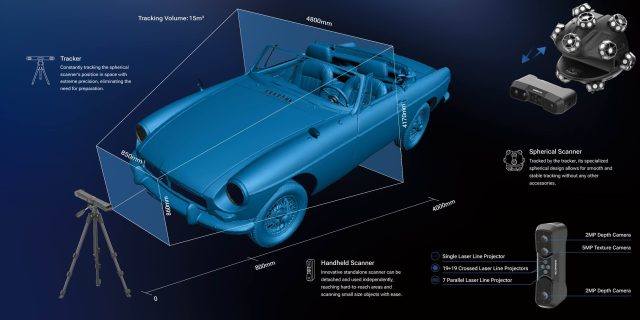


The scanner offers three blue laser configurations: a 19+19 cross-line array for accelerated area coverage, seven parallel lines for capturing sharp edges and fine details, and a single line for deep holes, narrow channels, and internal structures. The resolution range is 0.05 to 10 mm, with an acquisition rate of up to 2.63 million points per second. The maximum field of view is 4796 × 4174 mm at a working distance of 4000 mm in tracking mode, and 547 × 463 mm at a distance of 500 mm in handheld mode. The tracker weighs 1.02 kg, the spherical scanner weighs 1.46 kg, and the handheld scanner weighs 0.48 kg. Battery life is up to 5.5 hours in tracking mode and up to 3.5 hours in scanner mode, with a wireless transmission range of up to 4 meters. SHINING 3D states that its ambient light tolerance reaches 110,000 lux, and it can operate on black, reflective, and metallic surfaces.
The marker-free method relies on feature-based surface tracking, requiring the object to have sufficient geometric detail; for tasks requiring finer detail, global markers can still be used. The Hybrid Leapfrog function allows operators to reposition the tracker while maintaining tracking continuity, but four markers are required at each position. Wi-Fi 6 connectivity, a standalone LAN setup, automatic pairing, and hot-swappable batteries support continuous operation.
The scanner is equipped with two 2-megapixel depth cameras and one 5-megapixel texture camera, while the tracker houses a 5-megapixel camera. Output data can be imported into EXMeasure for dimensional analysis and geometric dimensioning and tolerancing (GD&T) inspection, and into EXModel for reverse engineering and CAD model generation. This launch follows SHINING 3D's introduction of the EinScan Rigil Lite earlier this year, as the EinScan series continues to expand.
Related Products

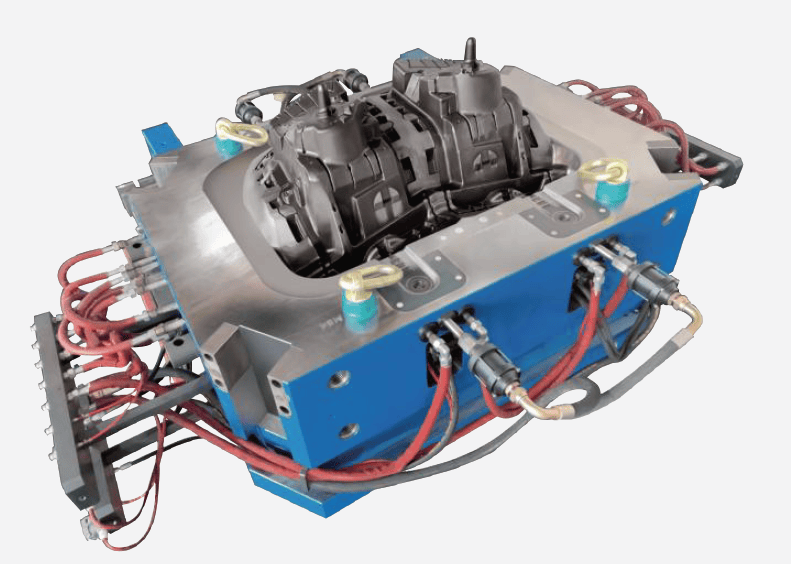
Aluminum-Magnesium Alloy High-Pressure Die-Casting Molds
NINGBO HELI TECHNOLOGY CO., LTD.
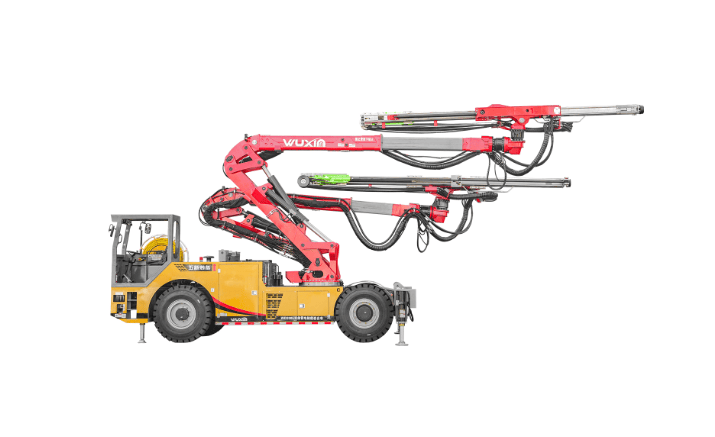
Double-Boom Computerized Rock Drilling Jumbo WD200E
Hunan Wuxin Intelligent Equipment Group Co., Ltd.
Standard Nozzle Flowmeter
Jinggong Automatic Control Instrument Complete Technology Development Company

Tactical Individual Carrying Handcart Platform
Automation Research Institute Co., Ltd. of China South Industries Group Corporation

High-Speed Flexible Fully Automatic Stamping Production Line
JIER Machine-Tool Group Co., Ltd.