Wedoany.com Report-Sept. 17, China’s Comprehensive Research Facility for Fusion Technology (CRAFT) successfully passed expert evaluation and acceptance for its remote-handling test platform on Monday, according to China Science Daily on Tuesday. The platform is designed to develop and test key components of fusion energy reactors, supporting the safe and efficient operation of future fusion systems.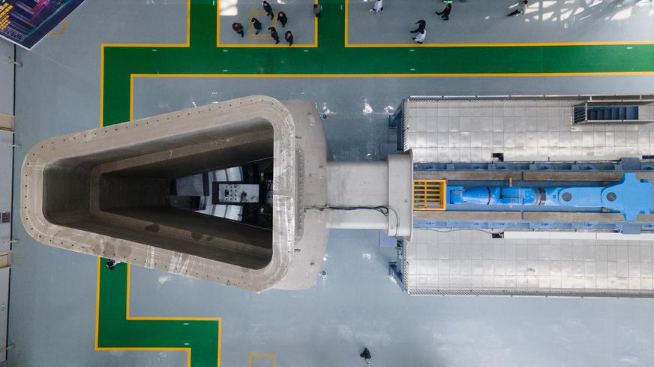
A drone photo taken on March 9, 2025 shows the one-eighth vacuum chamber and overall installation system, one of the key subsystems of the Comprehensive Research Facility for Fusion Technology (CRAFT), in Hefei, capital of east China's Anhui Province.
Field trials confirmed that the cladding-maintenance robot can handle payloads up to 60 tonnes with high toroidal positioning accuracy and precise vertical lifting, while the heavy-duty manipulator can carry 2.5 tonnes. These capabilities are critical because cladding and divertor components in fusion reactors are exposed to extreme conditions, including high heat flux, strong magnetic fields, and neutron irradiation, which make manual maintenance impossible.
The remote-handling platform addresses a longstanding challenge in fusion technology. Existing industrial robots cannot simultaneously endure intense radiation, manipulate heavy components, and maintain high operational accuracy while performing delicate tasks in a fusion reactor environment. The CRAFT platform overcomes this limitation, providing a core engineering verification system for future reactors.
By enabling precise robotic maintenance of reactor components, the platform supports the stable operation and commercialization of fusion energy. The system also establishes a transferable technology stack that can be applied beyond fusion energy, including nuclear power inspection and repair, aerospace engineering, heavy-equipment operations, and emergency-response missions.
CRAFT’s achievement demonstrates significant progress in China's efforts to advance fusion energy technology, a potential clean energy source capable of producing large amounts of power with minimal environmental impact. The platform’s design emphasizes safety, efficiency, and precision, aligning with global efforts to develop viable, scalable fusion reactors.
The evaluation process involved rigorous testing under simulated operational conditions, confirming the robots’ capacity to perform complex tasks while maintaining structural integrity and precision. The platform’s success is expected to accelerate research and development of fusion reactor components, paving the way for broader industrial adoption and collaboration.
Experts highlighted the platform’s ability to combine heavy-load handling, high accuracy, and radiation resistance as a key milestone in fusion engineering. It sets a foundation for next-generation fusion reactors, which require continuous monitoring and maintenance of core components to operate safely over long periods.
The commissioning of this test platform reflects China’s growing capabilities in advanced energy technologies and robotics integration. By enabling remote maintenance of highly stressed and irradiated components, CRAFT positions China at the forefront of global fusion research, while also providing solutions applicable in multiple high-tech and industrial sectors.
In summary, the CRAFT remote-handling test platform offers a robust, precise, and adaptable solution for fusion reactor maintenance, supporting both the safe operation of experimental reactors and the eventual commercial deployment of fusion energy. Its successful evaluation represents a strategic advancement in robotics, nuclear technology, and clean energy development, with wide-ranging applications beyond the fusion sector.