Wedoany.com Report-Oct. 21, Brazil's National Nuclear Energy Commission (CNEN) and China Isotope & Radiation Corporation (CIRC) have signed a memorandum of understanding (MoU) "to ensure the continuous and stable supply of radioisotopes used in areas vital to scientific and social development." The agreement was finalized last week during a side event at the 30th IAEA Fusion Energy Conference in Chengdu, China.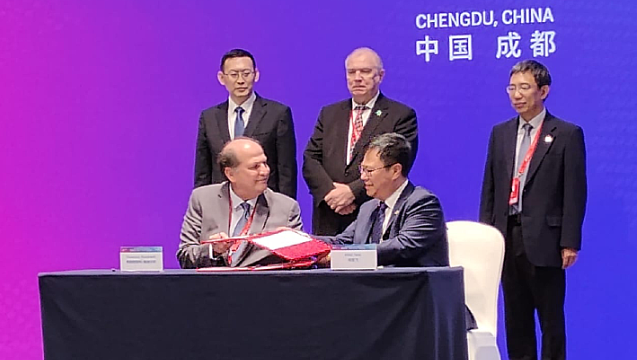
China Isotope & Radiation Corporation, a subsidiary of China National Nuclear Corporation (CNNC), will collaborate with CNEN under the MoU for an initial three-year period. During this time, both parties aim "to deepen studies on technical and commercial feasibility, based on sustainable business models and in accordance with the legislation of both countries."
CNEN emphasized that the agreement does not involve the transfer of financial resources but "reflects the commitment of the two nations to guarantee access to nuclear inputs indispensable for medicine, industry and research, strengthening the security of supply of these strategic materials."
The memorandum identifies several key radioisotopes, including iodine-131, lutetium-177, molybdenum-99, cobalt-60, carbon-14, and iridium-192, as well as other isotopes applied in healthcare, industrial production, and scientific research. CNEN noted: "Promoting access to these elements means contributing to advances in health, more effective treatments, and scientific innovation with a direct impact on society."
The MoU also highlights the broader objectives of international nuclear cooperation. CNEN stated: "The memorandum between Brazil and China translates, in a single gesture, the greater purpose of nuclear cooperation: to put science at the service of life."
This agreement strengthens collaboration in nuclear science between Brazil and China while ensuring reliable access to essential isotopes. It supports medical applications, industrial processes, and scientific research, promoting technological progress and societal benefits.
Both CNEN and CIRC will continue to work closely over the three-year period to evaluate technical and commercial aspects, assess feasibility, and identify opportunities for sustainable development in the nuclear sector. The MoU underscores a shared commitment to advancing nuclear technology while ensuring that critical materials remain accessible for health, industry, and research purposes.
By formalizing this cooperation, Brazil and China aim to reinforce the security of radioisotope supplies, encourage innovation, and support practical applications that benefit public health and scientific development. This partnership aligns with global efforts to leverage nuclear technology responsibly and for constructive societal impact.