Wedoany.com Report-Oct. 31, Volvo Cars’ Tāizhōu plant recently celebrated a major milestone, producing its 500,000th vehicle, an all-new Volvo XC70, as announced via the company’s WeChat account on October 30. The XC70, officially launched on September 26, is priced between 416,900 yuan and 496,900 yuan, with a limited-time promotion starting at 269,900 yuan.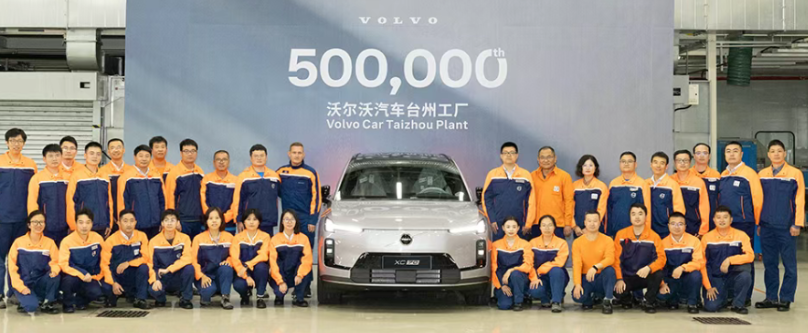
The new XC70 reflects Volvo’s Scandinavian design DNA, featuring signature "Thor's Hammer" LED headlights with adaptive high-beam and dynamic cornering functions. The vehicle measures 4,815 mm in length, 1,890 mm in width, 1,650 mm in height, and has a 2,895 mm wheelbase, providing a balanced mix of elegance and practicality.
Inside, the cabin emphasizes technology and simplicity. A 15.4-inch central touchscreen, 12.3-inch digital instrument cluster, and 92-inch augmented-reality head-up display create a seamless three-screen interface. With 24 smart sensors onboard, the vehicle supports intelligent parking and Volvo’s NPA assisted navigation system, enhancing safety and convenience.
The XC70 is powered by a 1.5-liter turbocharged engine paired with either a single-motor or triple-motor plug-in hybrid system (P1+P2+P4 configuration). The engine produces 120 kW and is connected to Volvo’s 3DHT hybrid transmission. The single-motor variant delivers 234 kW combined, powered by a 21.1 kWh LFP battery, providing 116 km electric range (CLTC) and 0–100 km/h acceleration in 8 seconds. The triple-motor version generates 340 kW combined, using a 39.6 kWh ternary lithium battery for 212 km electric range and over 1,200 km total driving range.
The Tāizhōu plant is central to Volvo’s global manufacturing network, operating under the VCMS system with a focus on safety, personalization, and sustainability. It serves as a benchmark for intelligent, green, and high-quality vehicle production and is a key hub for Volvo’s global new energy vehicle strategy.
In intelligent manufacturing, the plant uses 100% automation in its stamping line and 442 robots in welding operations. Its paint shop is 96% automated, while the final assembly line employs electric tightening tools with full torque traceability. A seven-tier quality inspection system—from procurement to assembly—uses ultrasonic weld testing, tear testing, and blue-light inspection to ensure consistency. Adaptive welding systems automatically adjust parameters based on sheet thickness.
On sustainability, the Tāizhōu plant achieved 100% carbon-neutral electricity in 2021 and climate-neutral operations by 2024. It introduced closed-loop recycling for aluminum and steel without quality loss and earned a three-star zero-landfill certification, the first automaker in Zhejiang Province to do so.
This milestone underscores Volvo Cars’ commitment to intelligent manufacturing, sustainable operations, and delivering advanced, high-quality vehicles to global markets.