Wedoany.com Report-Nov. 20, Nvidia (NVDA.O) and California-based startup Menlo Micro announced on Wednesday that they have jointly developed advanced testing technology capable of accelerating the validation of artificial intelligence processors by 30% to 90%, depending on the specific test procedure.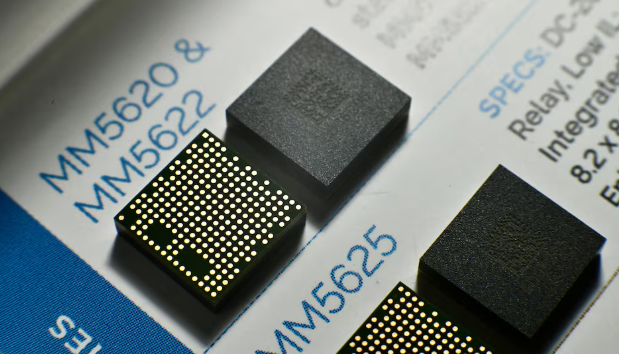
A switching chip, manufactured by Menlo Micro, an Irvine, California-based company, and used by Nvidia to test and validate its AI chips, November 18, 2025.
The collaboration addresses a key production constraint for Nvidia, which ships millions of high-performance GPUs annually. Each chip must undergo rigorous functional and performance verification on specialized test boards before delivery to customers.
Traditional test equipment relies on decades-old semiconductor switching components that struggle to keep pace with the power requirements and data rates of modern AI accelerators. Menlo Micro’s solution replaces these legacy parts with high-speed, micro-electromechanical (MEMS) metal switches that operate reliably at the voltages and frequencies required by Nvidia’s latest designs.
In a technical paper released Wednesday, engineers from both companies detailed how the new switching modules significantly reduce test times across multiple validation stages, enabling higher throughput in Nvidia’s final quality assurance process.
“The bottom line is, if you don’t validate the GPUs before you get into the data center, you’re going to have errors and other issues. This is the only way to validate these things at speed,” Menlo Micro CEO Russ Garcia said in an interview.
Menlo Micro, founded in 2016 as a spin-out from General Electric and backed by investors including Corning and Tony Fadell’s venture fund, has raised $227.5 million to commercialize its MEMS-based switching technology.
Garcia confirmed that several leading semiconductor manufacturers have begun adopting the same switching platform for their own high-performance chip testing, though he declined to disclose specific revenue figures from the Nvidia partnership.
The improved testing efficiency arrives as Nvidia prepares to report quarterly results after market close on Wednesday. Consensus estimates project fiscal fourth-quarter revenue of approximately $56.9 billion, representing 56% year-on-year growth, according to LSEG data.
The development helps alleviate one of the remaining bottlenecks in Nvidia’s supply chain as demand continues to outpace available production capacity for its most advanced AI accelerators.
By shortening validation cycles, the Menlo Micro technology allows Nvidia to process larger volumes of finished chips through existing test facilities without requiring proportional increases in floor space or capital equipment.
Industry sources indicate that similar high-reliability switching solutions are being evaluated across the semiconductor sector for next-generation processors used in data centers, automotive systems, and telecommunications infrastructure.
The joint achievement demonstrates continued innovation in back-end manufacturing processes that are essential to sustaining the rapid scaling of artificial intelligence computing worldwide.