India's Minister of State for Communications, Pemmasani Chandra Sekhar, held talks with the UK's Parliamentary Under Secretary of State for AI and Online Safety, Kanishka Narayan, on Wednesday. Both sides reaffirmed their commitment to strengthen cooperation in telecommunications, digital innovation, and emerging technologies.
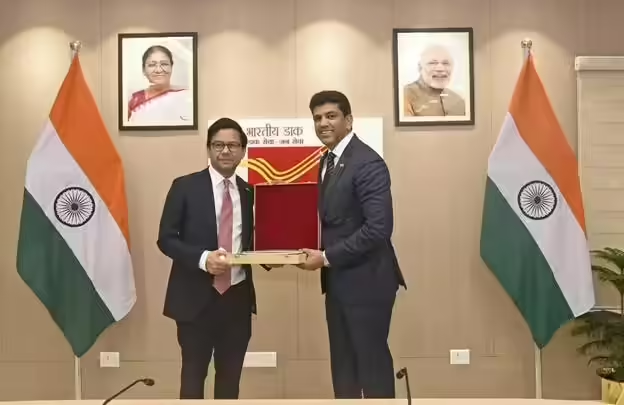
During discussions on the sidelines of the AI Summit, Chandra Sekhar stated that India views artificial intelligence as crucial for telecom development. He noted that combining India's market scale with the UK's research capabilities can help set global standards in areas like AI-native networks, Open RAN, and 6G technology, fostering technological growth and building mutual trust.
Chandra Sekhar also briefed on India's National Quantum Mission, highlighting opportunities for collaboration in quantum communication and secure networks. Both sides reviewed progress under the DoT-DCMS Memorandum of Understanding and acknowledged the planned India-UK Centre for Connectivity and Innovation, set to be operational at the India Mobile Congress 2025.
The talks focused on deepening collaboration in AI applications for telecom networks, covering autonomous network management, AI-driven cybersecurity, spectrum innovation, and non-terrestrial networks. They expressed willingness for joint research, pilot projects, and coordinated participation in global standardization forums like the ITU and 3GPP.
India and the UK also exchanged experiences on using AI to combat telecom fraud and digital scams. India shared details on financial fraud risk indicators, the Sanchar Saathi platform, and measures by telecom service providers using AI tools against spam and fraud detection. The UK outlined its approach based on an open data framework and regulatory deterrence.
India sought the UK's support on multilateral matters at the International Telecommunication Union, including support for M. Revathi's candidacy for Director of the ITU Radiocommunication Bureau and for India's re-election to the ITU Council for the 2027-2030 term, reflecting its contributions to global telecom governance and standardization. The meeting also discussed India's proposal to host the ITU Plenipotentiary Conference (PP-2030), showcasing India's efforts to promote an inclusive, secure, and forward-looking global digital ecosystem.
India also outlined its rapid 5G deployment, rural connectivity expansion, digital public infrastructure, and citizen-centric telecom governance initiatives. The meeting concluded with a commitment from both sides to enhance institutional engagement and jointly build secure and trusted digital infrastructure.