
A research team led by Chief Researcher Dae-Hwan Kim and Kee-Jeong Yang from the Department of Energy and Environmental Technology at the Korea Institute of Science and Technology has made significant progress in the field of eco-friendly solar cells. They have discovered a new technology that dramatically improves the efficiency of antimony selenide (Sb₂Se₃) solar cells through simple temperature control. As a next-generation environmentally friendly solar cell material, antimony selenide consists solely of abundant antimony and selenium on Earth, containing no harmful elements like cadmium or lead. It has attracted considerable attention due to its strong light absorption capacity and excellent thermal and chemical stability. However, traditional Sb₂Se₃-based devices suffer from low efficiency, primarily because random crystal orientation and structural defects impede charge transport.
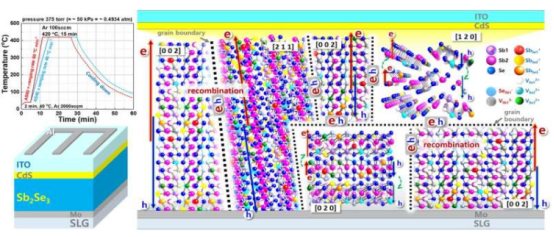
After in-depth exploration, the research team found that rapidly increasing temperature during the material's heat treatment process promotes more ordered crystal growth, reduces structural defects, and enables smoother charge transport. They conducted detailed defect characterization using various analytical techniques, including scanning electron microscopy and X-ray diffraction. The results showed that gradual temperature increases lead to random crystal orientation growth, increasing defects and hindering charge transport; in contrast, a faster heating process produces uniformly aligned crystals, allowing smoother electron flow and significantly higher efficiency.
Professor Yang from Professor Junho Kim's team at Incheon National University stated: "This study provides key insights into addressing crystal orientation and structural defect issues in antimony selenide solar cells. By controlling the crystal growth rate in the early stages of the preparation process, we can maximize the material's potential, which is expected to greatly facilitate future commercialization and the development of large-area modules." The research findings have been published in the Journal of Materials Chemistry A.