
The CPfS research team at the Max Planck Institute of Technology has achieved controllable atomic defect preparation in superconducting nickelate thin films using high-energy electron irradiation technology. This study, published in Physical Review Letters, systematically explores the impact of atomic defects on superconducting properties, providing new insights into understanding the nickelate superconductivity mechanism.
Superconductors exhibit properties such as zero resistance and complete diamagnetism, holding significant value in both fundamental research and applied technologies. Nickelates, as a novel unconventional superconductor material, have become a hotspot in condensed matter physics research since their superconductivity was first discovered by a Stanford University team in 2019. Compared to traditional cuprate superconductors, nickelate materials exhibit unique similarities and differences.
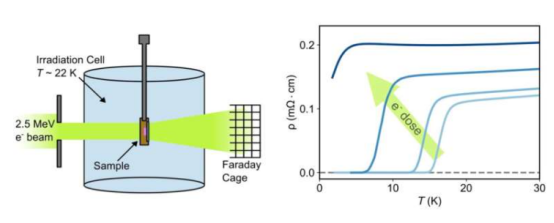
The research team collaborated with Stanford University and École Polytechnique in Paris, employing megavolt-level energy electrons to irradiate high-quality nickelate samples, gradually introducing atomic defects. As the atomic defect density increased, researchers systematically observed regular changes in the superconducting transition temperature. Different types of superconductors exhibit varying sensitivities to lattice disorder, and this method helps distinguish theoretical models of various superconducting mechanisms.
Researchers at the Max Planck Institute of Technology stated, "By controllably introducing atomic defects, we are able to gain a deeper understanding of the mechanism behind nickelate superconductivity." This study not only deepens the understanding of nickelate superconducting materials but also establishes a foundation for subsequent research on broader material systems. Atomic defect engineering provides new experimental avenues for exploring superconducting mechanisms.
This atomic defect modulation research also offers reference standards for optimizing material preparation processes. The controllable introduction of atomic defects achieved through electron irradiation technology demonstrates new ideas in material modification. Research on superconducting nickelate materials continues to advance, with the mechanism of atomic defects remaining an important direction for future studies.