
Researchers from Shinshu University, Morgan Advanced Materials, and other institutions have proposed a novel strategy for storing methane using graphene-coated porous carbon materials. The related results, published in the journal Nature Energy, bring new hope for the safe storage and transportation of methane.
Methane, as one of the most abundant natural gases on Earth, is widely used to power buildings and fuel vehicles. However, its safe storage and transportation face challenges due to its high flammability, requiring compression at high pressures of approximately 25MPa. Current high-pressure methane storage solutions rely on expensive equipment and infrastructure, and damage or failure to the equipment can lead to gas leaks, causing severe accidents such as explosions and fires.
The previously proposed adsorbed natural gas (ANG) method, which uses nanoporous materials to capture gas molecules at moderate pressures, suffers from reliability issues: a slight temperature increase can cause methane to release, not only resulting in gas loss but also potentially triggering hazards.
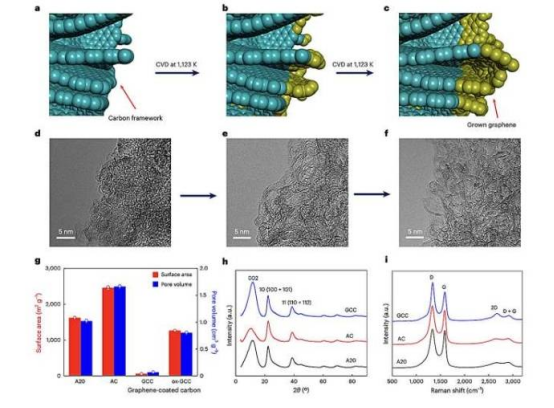
The new strategy proposed by the research team shows promising prospects. This approach utilizes graphene coatings and porous carbon-based materials to overcome the limitations of existing methane storage solutions. These materials can capture methane molecules under high pressure and retain them even under ambient pressure and temperatures below 318K. The researchers noted that graphene acts as a thermal control lock, capturing or releasing methane by blocking or activating pores, achieving a pressure-equivalent load of 19.9MPa at 298K, with release upon heating to 473K. The resulting reversible methane volumetric capacity reaches 142v/v, surpassing the volumetric capacities of various ANG materials at 3.5MPa and 298K.
Preliminary research results indicate that this methane storage strategy has enormous potential, being more effective and safer than current methods. After further testing and validation, this new strategy is expected to be deployed in real-world environments, significantly reducing the risks and difficulties associated with transporting this widely used fuel.