
Recently, scientists from the Skolkovo Institute of Science and Technology and the University of Granada in Spain have achieved a significant breakthrough in the field of architecture. They have discovered a method to save building materials and time when designing domes with folds and other wavy surfaces. The study has been published in the journal Engineering Structures.
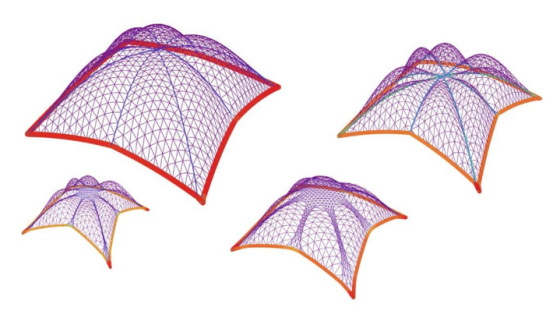
In architecture, economy and aesthetics are often seen as difficult to balance. People frequently sacrifice original forms to save costs or pursue beauty through complex and expensive solutions that may not be structurally rational. The study's first author, Anastasia Moskaleva, an engineer at the Skolkovo Institute's Center for Materials Technologies and a graduate of the university's Mathematics and Mechanics master's program, stated: "We have proven that aesthetics and economy are not mutually exclusive—a structure can be expressive, stable, and easy to manufacture."
If four columns or four walls are covered by a curved surface shell (such as a dome or vault), the structure itself is stiffer than a flat rectangular plate. If strength is insufficient, the entire dome area can usually be thickened, or reinforcing ribs can be added locally. Previously, a research group from Skolkovo Institute of Technology and the University of Granada had optimized the configuration of reinforcing ribs to enhance shells designed using the force density method.
In this new study, the researchers used the force density method to design the geometry of wavy or folded shells. Their increased strength does not come from material thickness or reinforcing bars but from the curvature of the surface itself. Moskaleva explained: "We explored how special 'geometric patterns' (which we call q-patterns) enhance the strength of architectural shells such as domes and vaults. To improve shell stiffness, we proposed a new method that uses predetermined load distribution patterns to shape the shell, 'stitching' ribs, waves, or folds into the structure. These folds make the shell more 'rigid,' bending or deforming less under load."
The researchers calculated the stability of wavy domes with five types of folded geometries, covering cases of overlapping four-point supports or four straight wall outlines. The calculation results showed that when supported by a wall outline, the wavy dome has a shape with the highest stability; when supported by columns, there is also an optimal stability shape. Additionally, an exceptional case was identified where the design loses stability at the minimum load regardless of the support type.
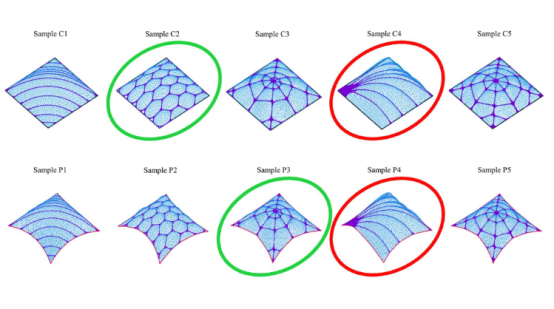
Moskaleva stated: "Our work expands the application of folded shells in architecture. Compared to continuously thickening surfaces, this liberates architects' creativity, saves computational resources and building materials. At the same time, it simplifies the structural design and manufacturing process. Making wavy domes from metal, reinforced concrete, or plastic is much easier than adding reinforcing bars to the shell. Depending on the material, adding reinforcing bars may require additional operations such as welding or mechanical fastening, increasing labor intensity and production costs. This method allows the shell to be completed in one step, such as through molding or casting, saving materials, reducing project costs, and speeding up the process."
The study employed an improved force density method developed specifically for designing folded shells using q-patterns, particularly suitable for calculating structures made from isotropic materials. In numerical modeling and finite element analysis, steel—a material with stable mechanical properties—was used. However, the method is not limited to steel and is also applicable to reinforced concrete, plastics, and other isotropic materials. Plastic shells can be used for small architectural forms such as pavilions, gazebos, and canopies, while curved steel structures are suitable for technical structures like those storing liquid fuels. The scientists noted that the method can also be applied to composite materials, including reinforced plastics, but requires consideration of anisotropic properties and more detailed numerical models.