
Researchers at the École Polytechnique Fédérale de Lausanne (EPFL) have made significant progress in robotics by developing a customizable soft robotics system. Powered by compressed air, this system can generate shape changes, vibrations, and other haptic feedback in various configurations, demonstrating broad application prospects in fields such as virtual reality, physical therapy, and rehabilitation.
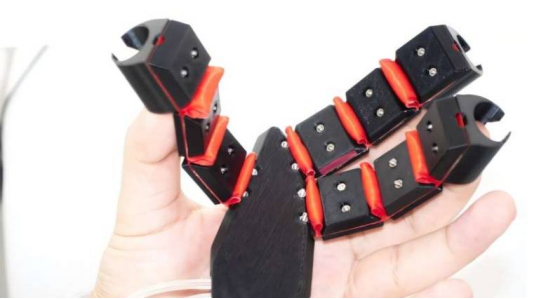
The Digits framework, developed by EPFL's School of Engineering Reconfigurable Robotics Lab, features 16 flexible and complex configurations while maintaining a relatively simple design. Each configuration consists of multiple modules (Digits) connected by rigid links and flexible joints, with the joints controlled by pressurized airbags to alter the module's shape and stiffness.
In a study published in Advanced Intelligent Systems, Reconfigurable Robotics Lab director Jamie Paik and her team showcased two Digits configurations—TangiGlove (wearable) and TangiBall (handheld)—fully demonstrating the framework's versatility.
PhD student and first author Serhat Demirtas explained that haptic interfaces can enhance virtual reality experiences by simulating real-world touch and support rehabilitation through interactive systems, but there is indeed a need for more universal reconfigurable design and control methods.
Thanks to its modular design, the Digits framework has wide-ranging application potential, covering configurations for progressive muscle training, motor recovery, and haptic interfaces in virtual environments. Since haptics requires complex actions like friction or grasping to perceive texture, temperature, weight, shape, or hardness—unlike other human senses such as vision and hearing—haptic technologies are typically developed for single purposes or aspects, making it extremely challenging to create systems that are adaptive, scalable, and deliver realistic haptic experiences. The Digits framework successfully addresses this challenge using the lab's signature reconfigurable robotics technology.
The Digits framework encompasses both closed-chain and open-chain categories of robotic structures. The open-chain TangiGlove functions like an exoskeleton, providing stiffness feedback to the wearer; the closed-chain TangiBall, composed of four connected Digits, not only provides stiffness feedback but can also present up to eight different shapes, from cubes to spheres, and both devices can generate vibrations.
In addition to modular design, the Digits framework's focus on pneumatic (compressed air) actuation is noteworthy, representing an underexplored area in personalized haptic experiences within robotics. To address this gap, the scientists expanded the open-source robotics software Feelix, enabling users to create custom pneumatic haptic interaction profiles. A machine learning-based system can sense changes caused by touch in the Digits modules, creating new intelligent and intuitive interactions without any coding.
Currently, the team plans to develop the technology's potential in rehabilitation by evaluating therapeutic scenarios and long-term usability. They are also exploring broader applications through new configurations, particularly those that can leverage the device's ability to rapidly switch between different sizes, shapes, and hardness levels—a prerequisite for real-time interaction in virtual and augmented environments.
Jamie Paik emphasized that the goal of developing the Digits modules is to redefine human-machine interaction through reconfigurable robotics. These robots can adjust shape, hardness, and haptic feedback to provide everyone—regardless of body type, ability, or needs—with more realistic virtual reality, more effective rehabilitation, and richer experiences.