
Recently, Professor Changduk Yang and his research team from the School of Energy and Chemical Engineering at Ulsan National Institute of Science and Technology (UNIST) in Korea announced the development of a novel semi-transparent organic solar cell (ST-OSC) with an energy conversion efficiency (PCE) of 10.81% and a visible light transmittance of 45.43%. The related research results were published in the journal Angewandte Chemie International Edition. This achievement brings the future of windows and mobile displays as invisible power sources one step closer.

Traditional solar panels are mostly installed on rooftops or roadsides, appearing relatively dark due to sunlight absorption for power generation. In contrast, transparent solar cells need to allow most light to pass through, making the development of efficient transparent devices a formidable challenge.
The key to this innovation lies in a specially designed photoactive layer that selectively absorbs infrared wavelengths. This layer transmits nearly half of the visible spectrum while collecting energy from the infrared portion of sunlight, which is invisible to the human eye, to generate electricity. Typically, capturing infrared light has lower efficiency than absorbing high-energy visible photons, but the research team overcame this challenge through innovative molecular design of the active layer's acceptor molecules. In organic solar cells (OSCs), the active layer consists of donor molecules and acceptor molecules that facilitate charge transfer.
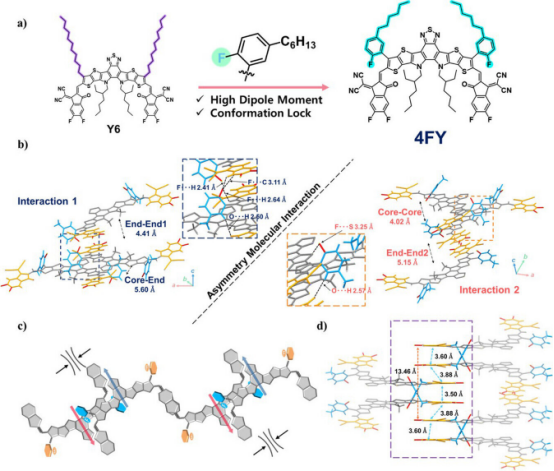
The newly synthesized acceptor molecule by the research team is named 4FY, which has an overall symmetric A-D-A structure. However, it was deliberately designed to induce local asymmetry, particularly between fluorine and hydrogen atoms, as well as between fluorine and sulfur atoms, to enhance molecular alignment, improve charge transport, and thereby increase device efficiency.
The study's first author, Sangjin Yang, explained that while asymmetry can improve efficiency, it often shortens device lifespan and complicates synthesis. This molecular design introduces local asymmetry within an overall symmetric structure, fully leveraging the advantages of both.
Notably, the device demonstrates excellent durability. In a 134h outdoor cycling stability test simulating day-night conditions, it retained most of its initial performance, with durability approximately 17 times higher than previous semi-transparent OSCs based on Y6 acceptor molecules.
Professor Changduk Yang commented that the team introduced a new method to generate electricity using invisible light. This technology has potential applications in smartphone protective films, building windows, and transparent displays, promising to turn everyday surfaces into invisible power plants.