
The research team led by Professor Hu Linhua from the Hefei Institutes of Physical Science, Chinese Academy of Sciences, has achieved a significant breakthrough by using urea as a zinc-philic solubilizer and cost-effective, environmentally friendly zinc acetate (Zn(Ac)₂) salt as the raw material to successfully develop a highly durable hydrogel electrolyte for aqueous zinc-ion batteries (AZIBs). The related research results were recently published in Angewandte Chemie International Edition.
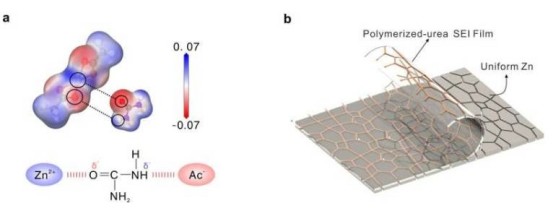
This novel hydrogel exhibits excellent performance, withstanding 557% tensile elongation and 3.7MPa compressive strength. During AZIB operation, the in-situ formed polyurea solid electrolyte interphase (SEI) enables stable zinc stripping/plating without dendrite formation or passivation. Team member Li Zhaoqian stated that this method overcomes the common limitations of low-cost zinc acetate salts, making the material more wear-resistant and capable of enduring repeated zinc plating/stripping processes and other physical stresses, significantly improving overall durability.
Aqueous zinc-ion batteries have long faced challenges such as electrolyte leakage and electrode corrosion. Quasi-solid electrolytes offer better stability and flexibility but fall short in cost-effectiveness, environmental friendliness, and fatigue resistance. Although zinc acetate is low-cost and eco-friendly, its poor solubility limits battery capacity and performance.
To address these issues, the researchers adopted a novel "salting-out" strategy, removing the hydration layer around polymer chains to increase zinc acetate solubility, strengthen the network structure, and enhance fatigue resistance, enabling the electrolyte to better withstand repeated electrochemical cycles and external mechanical deformation. During battery operation, a protective layer naturally formed on the electrode improves overall interface stability. The zinc-ion battery performs excellently; the flexible pouch battery maintains good capacity and stability even after multiple cycles, with outstanding flexibility—maintaining stable voltage under bending or folding—making it highly suitable for portable and wearable devices. Dr. Li Zhaoqian noted that the flexible pouch battery maintains stable voltage even at 180° bending, highlighting its application potential in portable and wearable electronics.
Additionally, the researchers evaluated the battery's rate performance and self-discharge behavior. The Zn//NH₄V₄O₁₀ battery using USPH-5 electrolyte still exhibits excellent capacity after repeated cycles, with strong discharge capability after prolonged standing, while batteries without this electrolyte show significant capacity loss, indicating that the new electrolyte material significantly enhances overall battery performance and long-term retention.
This study not only breaks through the salt solubility limitations in quasi-solid AZIBs but also provides scalable regulation strategies for other metal anodes, promising to drive the development of low-cost, environmentally friendly, and high-performance batteries.