
An international research team has successfully developed and tested a white paint called CCP-30, demonstrating outstanding performance in building protection and energy efficiency, offering an innovative solution to cooling challenges in buildings amid global warming.
Currently, cooling systems account for about 20% of global electricity consumption. As greenhouse gas emissions rise, temperatures in megacities are significantly higher than in suburbs. Concrete and asphalt absorb solar energy and release heat continuously, while waste heat from car engines, industrial plants, and air conditioning systems exacerbates this. To prevent regional "overheating," scientists have been exploring passive cooling methods—natural heat dissipation via convection, radiation, or conduction—without additional energy-consuming devices.
Previously, commercial paints focused primarily on radiative cooling (reflecting sunlight and emitting heat into the environment), but they perform poorly in high-humidity regions. Water vapor absorbs radiation, trapping heat near the surface and raising local air temperatures.
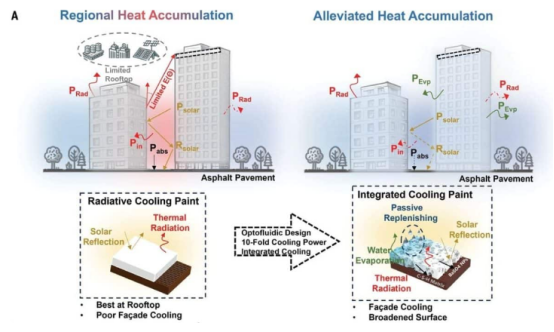
Researchers from Singapore, China, and Saudi Arabia published a study in Science proposing an effective solution: combining radiative cooling with evaporative cooling. The CCP-30 paint was developed based on this principle.
When the material faces the sky, the radiative cooling system activates, emitting heat absorbed by the building as infrared waves into space through the atmospheric transparency window, where they pass without being absorbed. For building sidewalls, CCP-30 has a unique mechanism: when coated on all four sides, it absorbs rainwater and atmospheric moisture, then evaporates it gradually like human skin, reducing surface heating.
The paint's non-swelling porous structure is made of calcium silicate hydrate (CSH gel), which retains moisture—the foundation of cement stone's strength and durability. The team added polymers, hygroscopic salts, and nano-additives to the gel-cement mixture to retain water and prevent cracking.

Scientists conducted experiments to validate CCP-30's performance. They tested three identical houses (50×40×70cm) built with 10cm thick industrial concrete blocks. One was coated with CCP-30, the second with a commercial cooling paint, and the third with standard white paint. Throughout the experiment, the CCP-30-coated house had the lowest indoor temperature—over 4.5°C cooler than the others—and its sidewalls remained cooler due to evaporative cooling.
To quantify energy savings, the researchers applied the three paints to concrete residences equipped with air conditioning and electricity meters. Over three days—regardless of sunny or rainy (high-humidity) conditions—CCP-30 saved 30%–40% of AC energy compared to the others. Monthly tests confirmed up to 40% electricity savings, with consistent results after two years.
Additionally, tests showed CCP-30 reflects 88%–92% of sunlight, emits 95% of heat as infrared radiation, and retains ~30% of its weight in water. Its cooling effectiveness is 10 times higher than standard paints, saving 30%–40% energy when applied to walls and reducing carbon footprint by 28%.
The CCP-30 paint, developed by this international team, provides a new, effective pathway for building cooling and energy efficiency, with potential for widespread global adoption to support sustainable development in the construction industry.