
The space debris problem is becoming increasingly severe. With the rising number of satellite launches, large amounts of discarded rocket bodies, damaged components, and defunct satellites have accumulated in low Earth orbit (LEO). These fragments not only risk colliding with satellites critical for navigation, communication, and weather forecasting but also pose threats to Earth's environment, such as damaging the ozone layer. To address this challenge, space agencies and private companies are exploring methods to clean up space debris and researching the use of organic polymers to replace metals in rocket and satellite manufacturing. Researchers Maximilian Berth and Kojiro Suzuki from the University of Tokyo have drawn inspiration from origami art to propose a sustainable space debris management solution.
In a study published in the Acta Astronautica, Berth and Suzuki envisioned a paper airplane launched from the International Space Station, flying in space at 7,800 meters per second. Software simulations showed that the paper airplane remained stable in the initial phase of space but began tumbling and spinning uncontrollably four days later upon reaching approximately 120 kilometers above Earth. The researchers explained that the low moment of inertia and aerodynamic static margin of the paper spacecraft allowed it to maintain stability during most of the atmospheric re-entry process, but below about 120 kilometers altitude, it would tumble with accompanying aerodynamic heating, ultimately burning up in the atmosphere.
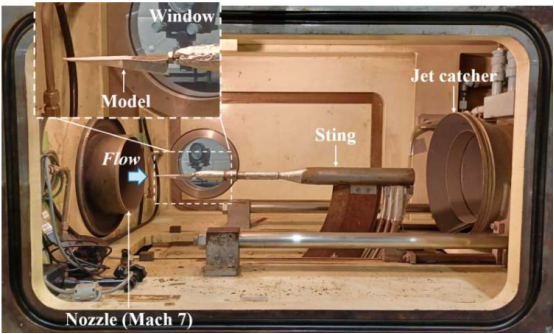
To further validate this, Berth and Suzuki created a physical model of the paper spacecraft and tested it in the University of Tokyo's Kashiwa hypersonic high-enthalpy wind tunnel. The model flew at Mach 7 for 7 seconds, resulting in the nose bending backward and wingtips charring, but it did not disintegrate. This experiment demonstrated that paper-based spacecraft possess a certain degree of heat resistance under specific conditions.
The study proposes that paper-based spacecraft could play a role in future missions, such as collecting Earth data and then completely burning up without leaving harmful substances. Although this idea is only a small step, it provides new thinking for sustainable space debris management, helping space exploration better protect the environment and make Earth safer.