
Amid surging demand for renewable energy, micro wind turbine technology has achieved a key breakthrough. A study led by the team of Shuo Zhang has, for the first time, confirmed that through synergistic design of counter-rotating dual turbines, micro devices can achieve a 37% increase in power output, providing an efficient solution for off-grid power supply. The related findings were published in the Journal of Renewable and Sustainable Energy.
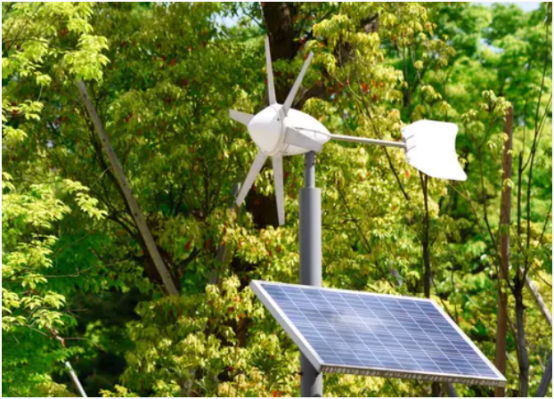
The research focuses on micro turbines with diameters under 20cm. While compact in size, these devices are important power sources for remote sensors, IoT terminals, and mobile electronic equipment. Traditional designs are limited by aerodynamic efficiency and cost bottlenecks, making it difficult to meet distributed energy needs. The team employed stereo particle image velocimetry (PIV) technology to capture, for the first time, the untapped rotational kinetic energy in the wake of a single turbine.
Experiments showed that when a second counter-rotating turbine is precisely placed 12 times the radius behind the first, it can efficiently capture the rotational energy in the wake and convert it into electricity. Even under turbulent conditions, this configuration demonstrates significant advantages over co-rotating systems. This phenomenon stems from the unique low-speed, high-torque operating characteristics of micro turbines, where the generated "twist" effect in the wind can be fully utilized by a custom-designed downstream unit.

"This is similar to the multi-stage supercharging principle in aircraft engines," the research team explained. "By optimizing the spacing and rotation direction between turbines, the micro system can simultaneously harness the wind's thrust and torsional forces, maximizing energy efficiency." Test data indicate that the optimized dual-turbine system increases energy capture efficiency by nearly 40% compared to a single unit while maintaining a compact size.
This breakthrough opens new pathways for distributed energy applications. Enhanced micro turbine systems can reliably support off-grid community infrastructure power supply and provide long-term charging solutions for mobile devices such as drones and agricultural robots. The team emphasized that further adjustments to turbine spacing and arrangement could reduce the cost per unit of electricity generated, making energy supply in remote areas more economically viable.
As global exploration of sustainable energy technologies deepens, micro wind turbines are transitioning from auxiliary power devices to mainstream energy solutions. The research by Shuo Zhang's team not only provides a theoretical blueprint for device optimization but also promotes the large-scale application of distributed energy systems through replicable technical pathways. Industry forecasts suggest that once this technology matures, it will significantly lower energy deployment costs for IoT devices, environmental monitoring networks, and similar scenarios, accelerating the global clean energy transition.