
An international team of astronomers, using observational data from NASA's Imaging X-ray Polarimetry Explorer (IXPE) and other telescopes, has discovered new evidence to explain the interaction mechanism between the pulsing remnants of exploded stars and surrounding matter in the deep cosmos. The study focused on a mysterious cosmic binary system named PSR J1023+0038 (abbreviated as J1023). This system consists of a rapidly rotating neutron star and a low-mass companion star, where the neutron star accretes material from its companion, forming an accretion disk around it, while also behaving as a pulsar, emitting lighthouse-like dual beams from its magnetic poles during rotation.
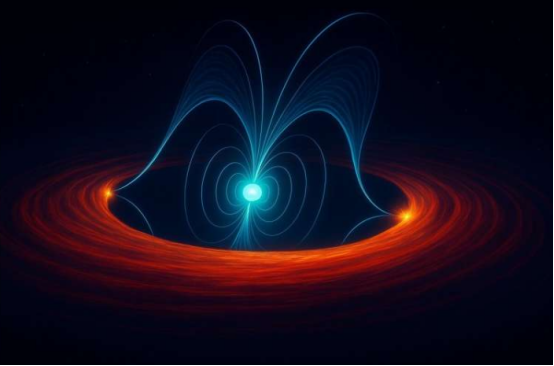
The J1023 pulsar system has attracted attention due to its clear transitions between active and dormant states, known as a "transitional millisecond pulsar." "Transitional millisecond pulsars serve as cosmic laboratories for studying neutron star evolution in binary systems," said Maria Cristina Baglio, lead author of the related paper in The Astrophysical Journal Letters and researcher at Italy's National Institute for Astrophysics in Merate. Scientists have long puzzled over the source of X-rays in this system, which is crucial for theories on particle acceleration and accretion physics.
The results show that the X-rays originate from the pulsar wind—a mixture of gas, shock waves, and other components impacting the accretion disk. To confirm this, astronomers used IXPE to observe X-ray polarization and compared it with optical polarization from Chile's Very Large Telescope. IXPE was launched in December 2021, and J1023 was the first such system it explored. Additionally, NASA's Neutron Star Interior Composition Explorer (NICER) and other instruments provided valuable data. Ultimately, scientists found that the polarization angles were identical across different wavelengths. Francesco Coti Zelati from the Institute of Space Sciences in Barcelona, Spain, stated that this proves the observed light is supported by a single physical mechanism. The study challenges traditional views, indicating that X-rays come from the pulsar wind rather than the accretion disk. Astronomers will continue studying transitional millisecond pulsars to refine theoretical models and fully understand the physical mechanisms of these cosmic systems.