
As the world actively addresses the urgent need to reduce carbon emissions and combat climate change, researchers at the University of Sharjah are focusing on a cutting-edge technology that could reshape the future of energy—artificial intelligence digital twins. Environmental scientists believe that fossil fuels are linked to global warming, and these digital replicas of the physical world have the potential to transform energy production, management, and optimization across various clean energy platforms, accelerating the transition away from fossil fuels.

Digital twins, with their ability to replicate and interact with complex systems, have become a cornerstone of innovation across industries, driving efficiency improvements, cost reductions, and the development of new solutions. However, scientists warn that current digital twin models have significant limitations, restricting their ability to fully harness the potential of energy sources such as wind, solar, geothermal, hydropower, and biomass.
In a study published in Energy Nexus, the researchers noted that digital twins have shown remarkable effectiveness in optimizing renewable energy systems, but each energy source presents unique challenges—from data variability and environmental conditions to system complexity—that can limit the performance of digital twin technology.
In the study, the authors conducted an extensive review of existing literature on digital twin applications in renewable energy systems, examining various environmental, functional, lifecycle, and architectural frameworks to understand current applications and identify gaps. To extract meaningful insights, they employed advanced text mining techniques, integrating artificial intelligence, machine learning, and natural language processing to analyze large volumes of raw data, uncovering structured patterns, concepts, and emerging trends.
Through in-depth analysis, the authors drew key conclusions, highlighting research gaps, proposing new directions, and outlining the challenges that must be addressed to fully realize the potential of digital twin technology in the renewable energy sector. After a detailed discussion of digital twin integration in various renewable energy applications, the authors summarized key findings across the five major energy sources—wind, solar, geothermal, hydropower, and biomass—providing a comprehensive overview of how digital twins can be tailored to optimize performance in each area.
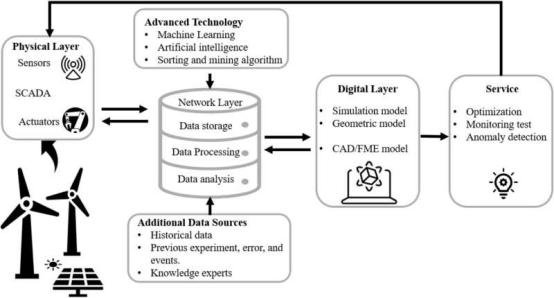
The research shows that digital twins offer significant advantages for various renewable energy systems: In wind energy, they can predict unknown parameters and correct inaccurate measurements, improving system reliability and performance; in solar energy, they help identify key factors affecting efficiency and output power, enabling better system design and optimization; in geothermal energy, they can simulate the entire operational process, facilitating cost analysis and reducing time and expenses; in hydropower, AI-driven models can simulate system dynamics, mitigating the impact of worker fatigue on productivity in aging hydroelectric plants; in biomass energy, they enhance performance and management through deeper understanding of operational processes and plant configurations.
However, the authors also pointed out critical limitations of digital twins in applications across different renewable energy systems: In wind energy, challenges exist in precise modeling and monitoring of environmental conditions, making it difficult to simulate key factors like blade corrosion; in solar energy, reliable long-term performance prediction is insufficient, and tracking solar panel aging is challenging; in geothermal energy, lack of high-quality data hinders the ability to simulate geological uncertainties and subsurface conditions, with long-term behavior simulation being complex; in hydropower, accurately simulating water flow variations and capturing environmental and ecological constraints is difficult; in biomass energy, simulating the entire production supply chain is challenging, with no precise models available for biological processes.
The authors emphasized the broad impact of these shortcomings on the renewable energy field and provided a set of guidelines and a research roadmap, recommending improvements in data collection methods, advancements in modeling techniques, and expansion of computational capabilities to enhance the reliability and accuracy of digital twin technology, providing dependable insights for decision-making and system optimization.