
Researchers at Northeastern University in the United States have developed a flexible robotic arm named SCCRUB, bringing a new breakthrough to the field of household cleaning. The related research results have been published on the arXiv preprint server.
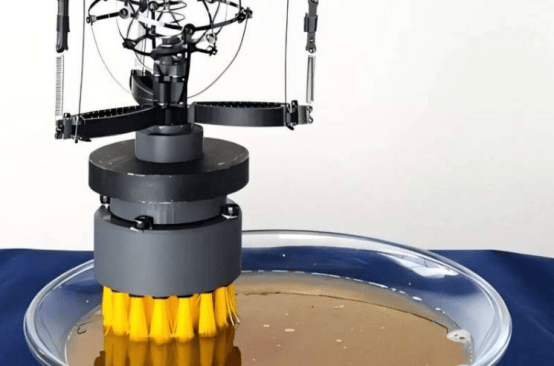
Currently, commercial robotic systems are mostly limited to autonomous floor cleaning. Robots capable of reliably performing other household tasks—such as cleaning surfaces, tidying rooms, or cooking—are either too expensive or not yet available on the market. The newly developed SCCRUB flexible robotic arm can perform surface scrubbing beyond vacuuming and mopping. It successfully cleans dirty, burnt, and greasy surfaces, removing over 99% of residues.
This research builds on a previous paper published in Science Robotics. To test the effectiveness of the soft robotic arm, the researchers were inspired by brush attachments for drills available on Amazon and integrated them with the robotic arm. The researchers noted that while powerful robotic arms can perform high-intensity cleaning, they are unsafe around humans. In contrast, the SCCRUB arm combines flexibility and rigidity: it is soft and safe while being strong enough to use brushes to remove stubborn dirt.
The SCCRUB robotic arm consists mainly of three components: a counter-rotating scrubbing brush, a novel software controller based on deep learning (which plans cleaning actions), and the previously developed TRUNC unit. The TRUNC unit can transmit torque while bending, extending, and telescoping. When connected in series and nested, it creates a lightweight and soft robotic arm capable of delivering torque equivalent to that of a hand drill. It can work safely around people while providing cleaning power.
Its movements are planned by a machine-learning-based controller to ensure the components reach the required positions while maintaining arm flexibility. The arm is also equipped with brush attachments to remove dirt and residues. The brush attachment uses a planetary gearbox to make the brush rotate in the opposite direction, counteracting frictional forces so that the cleaning arm can press firmly against the surface and maintain position.
In a series of experiments, the SCCRUB robotic arm prototype successfully cleaned a glass plate stained with ketchup and a toilet seat covered with blueberry jam, removing nearly all residues. The researchers stated that this soft arm can operate in human spaces, delivering the power typically found only in rigid robots.
Currently, the research team plans to continue improving the robotic arm and expand the range of household tasks it can handle, moving it from the laboratory into real life. The researchers hope that one day soft robotic arms will safely assist humans in various scenarios, including industrial environments and everyday household chores.