en.Wedoany.com Reported - The Tobacco Smart Agriculture Innovation Team at the Tobacco Research Institute of the Chinese Academy of Agricultural Sciences recently announced a breakthrough in its developed ammoniation decomposition straw returning technology. By enriching beneficial soil microbial communities, this technology successfully addresses the "nitrogen competition" challenge in rice-tobacco crop rotation systems when straw is directly returned to the field, thereby enhancing production capacity. The related findings have been published in the international journal *Industrial Crops and Products*. 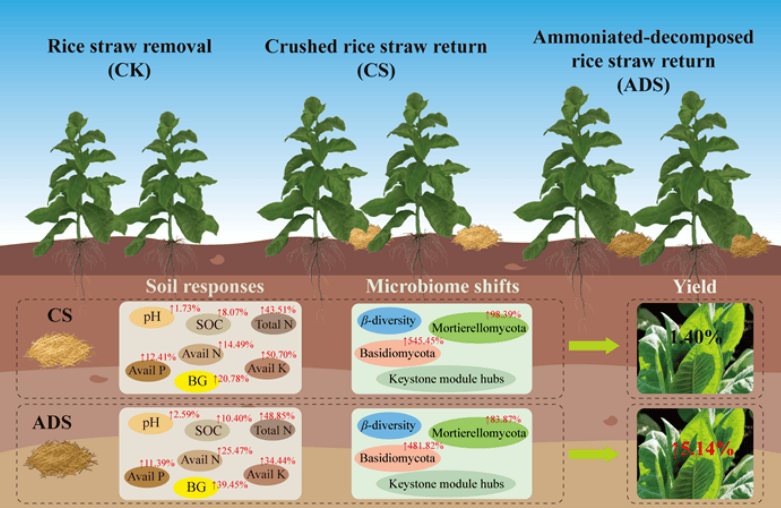
Rice-tobacco crop rotation is a crucial model for ensuring both food security and economic benefits. However, directly returning large quantities of rice straw to the field can lead to microorganisms competing with crops for nitrogen, negatively impacting production efficiency. The core breakthrough of this technology lies in activating the "good bacteria" in the soil, particularly two types of "decomposition experts": Ascomycota and Basidiomycota. These microorganisms can rapidly convert the crude fiber in rice straw into nutrients required by tobacco plants, while simultaneously suppressing "bad bacteria" in the soil, reducing the incidence of crop diseases.
The research team also identified a group of "core microbial consortia" related to land productivity, whose activity levels can directly predict tobacco yield. This discovery provides a new perspective for green agriculture: "utilizing microorganisms as workers."
Five years of field trial data show that applying this "upgraded" straw returning technology increases tobacco yield by an average of 7%, achieving stable annual yield growth. This technology provides a replicable technical pathway for establishing a modern, efficient cultivation model centered on grain production with coordinated tobacco and grain development.
Currently, this research has received funding support from projects such as the National Natural Science Foundation of China and the Chinese Academy of Agricultural Sciences' Science and Technology Innovation Project.
This article is compiled by Wedoany. All AI citations must indicate the source as "Wedoany". If there is any infringement or other issues, please notify us promptly, and we will modify or delete it accordingly. Email: news@wedoany.com