Pumped Hydro and Gravity Storage: The Large-Capacity Foundation of Physical Storage Is Returning
Among all Physical energy storage technologies, pumped hydro is the most mature and the closest to traditional power infrastructure. It uses low-cost or surplus electricity to pump water to a higher elevation, then releases it to generate power during peak demand or grid stress. Essentially, pumped hydro is not merely a storage device. It is a power asset capable of peak regulation, frequency control, reserve provision, black start, and system security support.
The renewed interest in pumped hydro is driven first by rising renewable penetration. The more wind and solar a system has, the more it needs large-capacity, long-life, dispatchable resources. Pumped hydro offers long lifetime, large project scale, long storage duration, and mature operating experience. For grid companies and power planners, it is closer to power system infrastructure than a short-cycle equipment investment.
China is one of the clearest examples of pumped hydro expansion. Reuters, citing International Hydropower Association data, reported that China added 7.75 GW of pumped storage in 2024, bringing total capacity to 58.69 GW, with more than 200 GW under construction. By 2030, China could reach 130 GW of pumped storage capacity, exceeding its target. This shows that in high-renewable power systems, pumped hydro remains a critical asset for grid stability.
However, pumped hydro also has clear constraints. Conventional projects depend on upper and lower reservoirs, elevation differences, land, water resources, ecological assessment, and long approval cycles. The United Kingdom, Australia, India, Southeast Asia, and Latin America all have development potential, but projects are often slowed by financing, environmental concerns, community acceptance, and tariff design. Therefore, future competition in pumped hydro is not just about identifying resource sites. It is about integrated development capability.
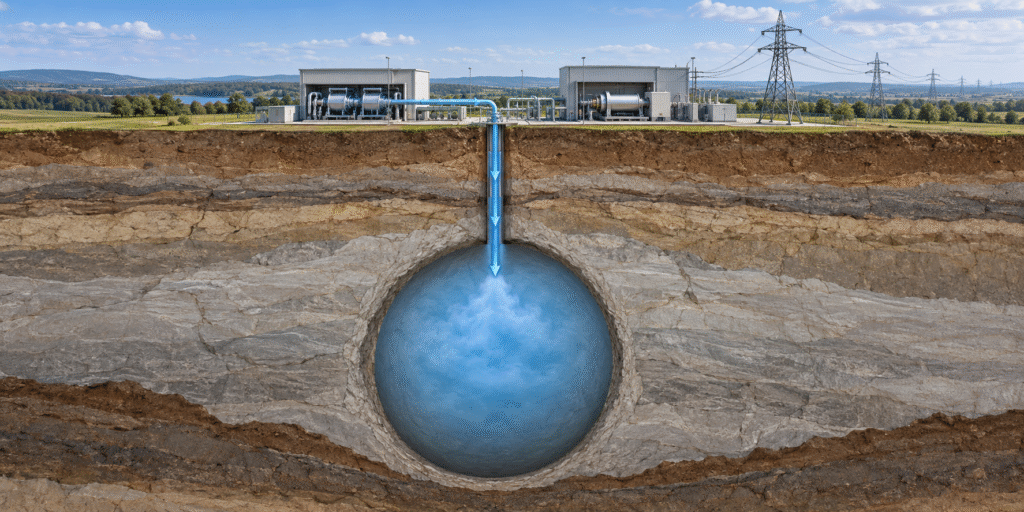
Gravity storage extends the same logic. It also uses potential energy, but does not necessarily rely on water. It can store energy through lifted weights, mine shafts, slopes, building structures, or underground spaces. Its advantages include long theoretical lifetime, low safety risk, recyclable materials, and suitability for some mining and industrial scenarios. Its limitations are that commercial projects remain limited, while system efficiency, engineering cost, and scalability still require further validation.
In the future, pumped hydro and gravity storage will form two layers. Pumped hydro will undertake national and regional power system regulation and is suitable for long-term power planning and grid investment. Gravity storage will serve as a scenario-specific supplement in mines, abandoned shafts, industrial parks, islands, mountainous areas, and special terrain conditions.
For industrial companies, the key is not to package these technologies as new concepts, but to return to engineering fundamentals: site selection, civil works, electromechanical equipment, grid connection, dispatch, ecological compliance, long-term O&M, and capital recovery. The larger physical storage becomes, the less it resembles consumer electronics and the more it resembles a cross-disciplinary infrastructure industry involving hydropower, grids, mining, and heavy engineering.