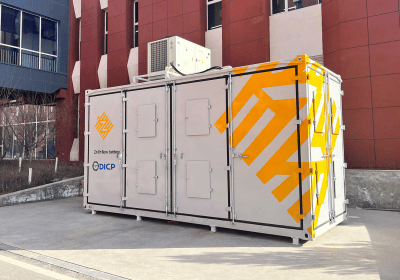
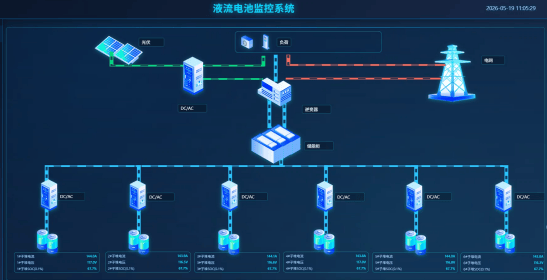
en.Wedoany.com Reported - The team led by Researcher Li Xianfeng and Researcher Yuan Zhizhang from the Energy Storage Technology Research Department (DNL 17) at the Dalian Institute of Chemical Physics (DICP) has developed a 250 kWh zinc-bromine flow battery system, which has been connected to the grid and put into operation at the Yulin Clean Energy Innovation Institute, Chinese Academy of Sciences. The system consists of electrolyte storage tanks, cell stacks, and a power control module. Designed with a total discharge energy of 250 kWh, the system achieved an actual discharge energy of 259.2 kWh, with an energy density exceeding 60 Wh/L (calculated based on the total volume of electrolyte on both sides).
The system employs a 50 kWh-class high areal capacity cell stack and a novel high-stability electrolyte developed by the team. In collaboration with the team led by Researcher Zeng Peng and Project Researcher Cui Shijie from the Shenyang Institute of Automation, Chinese Academy of Sciences, an intelligent electronic control design was implemented to assess the battery's operating status in real time. This enabled adaptive balancing and independent control of the cell stacks, overcoming the technical challenge of poor voltage consistency in series-connected multi-stack systems and enhancing system reliability.
Zinc-bromine flow battery energy storage technology offers advantages such as high safety, low electrolyte cost, and high energy density, presenting promising application prospects in the field of distributed energy storage. However, its large-scale application still faces challenges related to efficiency and reliability, stemming from the difficulty in regulating the zinc deposition process on the negative electrode, bromine diffusion on the positive electrode, and low electrode reaction kinetics.
The Energy Storage Technology Research Department at DICP places equal emphasis on fundamental and applied research. By constructing multi-scale mass transfer-reaction coupling pathways and regulating heat and mass transfer processes at the membrane-electrode interface, the team achieved synergistic optimization of interfacial flow field and electric field distribution, promoting uniform zinc deposition and enhancing areal capacity (J. Am. Chem. Soc., 2025; Angew. Chem. Int. Ed., 2025; Energy Environ. Sci., 2024). They established a molecular engineering regulation theory for solvation structures, resolving the issues of positive electrode bromine corrosion on battery materials and self-discharge (Adv. Mater., 2020), thereby improving battery cycle stability and energy density. Combined with structural design of the cell stack, the team developed a 50 kWh-class zinc-bromine flow battery stack.
The development of the 250 kWh zinc-bromine flow battery system lays a foundation for the integration and promotion of MW-level and larger zinc-bromine flow battery systems, contributing to the advancement of user-side flow battery energy storage technology. The above work was supported by projects including the Special Program of the Chinese Academy of Sciences and the Energy Revolution Science and Technology Special Project of the Yulin Clean Energy Innovation Institute, Chinese Academy of Sciences.
This article is compiled by Wedoany. All AI citations must indicate the source as "Wedoany". If there is any infringement or other issues, please notify us promptly, and we will modify or delete it accordingly. Email: news@wedoany.com