en.Wedoany.com Reported - Z-COM, a wireless networking company from Taiwan, China, recently announced that it will officially launch the NEW edge-native infrastructure platform at COMPUTEX 2026, held from June 2 to 5. Targeting enterprise campuses, system integrators, and channel partners, this platform integrates network control, wireless access, local intelligent operations, and energy management into a single operational layer, aiming to reduce enterprise reliance on external cloud-based management models.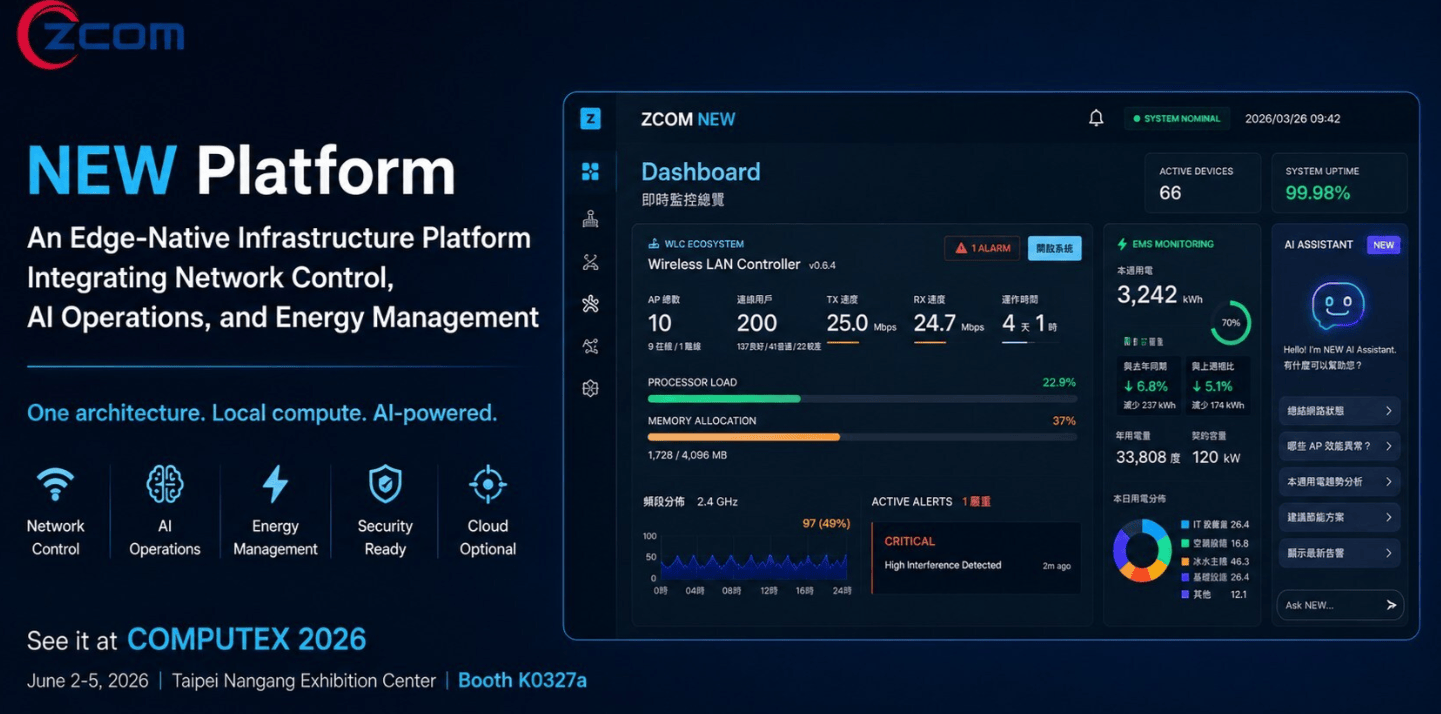
Z-COM's NEW, which stands for Network Extension with Wire and Wireless, is positioned as an edge-native unified operations architecture. The platform incorporates modules such as Cronus WLAN Controller for centralized access point management, RADIUS authentication, portal integration, wireless network visualization, intelligent RF monitoring, anomaly detection, Wi-Fi 7 indoor positioning, energy management, network security extension, and an intelligent operations assistant into a single system. Enterprises can license and use these modules on demand based on actual scenarios. Compared to traditional wireless controllers or point network management tools, NEW emphasizes that all intelligent services run locally, independent of external cloud intelligence capabilities. This is particularly significant for industrial parks, hospitals, campuses, hotels, commercial complexes, transportation hubs, and data-sensitive enterprises. In the past, enterprise wireless networks primarily addressed coverage, capacity, and authentication issues. However, with the integration of video surveillance, mobile office, IoT terminals, positioning and navigation, visitor systems, and energy management, network infrastructure has become part of on-site operational systems. Z-COM incorporates the AS710 Wi-Fi 7 indoor access point into the Cronus WLAN Controller for centralized management and ensures compatibility with Wi-Fi 7, Wi-Fi 6, and Wi-Fi 5 deployments. This means enterprises can gradually integrate the new platform during their existing network evolution without needing to replace all terminals and access devices at once. For medium-to-large enterprises and system integrators, the value of such a platform lies in consolidating wireless networks, on-site data, energy consumption status, and anomaly handling processes into a single management interface. This improves local operations response speed and provides a unified foundation for subsequent smart buildings, industrial IoT, and high-density wireless scenarios.
Z-COM, headquartered in the Hsinchu Science Park in Taiwan, China, was founded in 1995 and has long been engaged in wireless network hardware and software R&D. Its solutions have been deployed in European and Asian markets.
Enterprise networks are shifting from "connecting devices" to "managing on-site operations." In the past, many wireless network constructions focused primarily on bandwidth, coverage, number of access points, and authentication capabilities, with operations teams typically locating problems only after failures occurred. Now, wireless networks in enterprise scenarios must simultaneously support personnel mobility, changes in terminal density, on-site production data, indoor positioning, energy consumption monitoring, and security policy enforcement. By running wireless network visualization, anomaly detection, and intelligent operations assistants on the local edge, the NEW platform enables enterprises to more quickly detect, diagnose, and address issues such as network congestion, RF interference, access anomalies, device status changes, or abnormal energy consumption. The inclusion of an energy management module also reflects that enterprise network equipment is no longer just an IT asset but is being integrated into facility operations and energy-saving management systems. For system integrators, a unified platform helps package wireless coverage, authentication, positioning, energy, security, and operations services into replicable solutions, reducing data fragmentation across multiple systems. For end customers, localized processing reduces reliance on external clouds, making it easier to establish stable capabilities in data compliance, low-latency control, and continuous on-site operation. As Wi-Fi 7 enters the enterprise deployment cycle, improved access point performance is only the first step. Factors truly affecting project outcomes include controller capabilities, visualized operations, business module expansion, and cross-generational device compatibility. Z-COM's transition from a hardware manufacturer to an infrastructure platform provider aligns precisely with the trend of enterprise wireless networks upgrading from device procurement to platform-based operations.
The subsequent variables for this platform focus on enterprise customer validation, module licensing models, integration costs with existing IT systems, the pace of large-scale Wi-Fi 7 access point deployment, and the stability of local intelligent operations in complex scenarios. If NEW can generate batch cases in campuses, healthcare, education, hotels, and industrial sites, wireless network equipment companies from Taiwan, China, may gain new growth opportunities in the enterprise edge infrastructure market. Enterprise wireless networks will also increasingly take on responsibilities for on-site data management and operational optimization.
This article is compiled by Wedoany. All AI citations must indicate the source as "Wedoany". If there is any infringement or other issues, please notify us promptly, and we will modify or delete it accordingly. Email: news@wedoany.com