en.Wedoany.com Reported - The multimodal simulation technology of Umovity Software, part of the PTV Group, is being used to plan crowd and traffic management during the 2026 FIFA World Cup, which is expected to attract over 5 million fans to attend 104 matches across three North American countries.
"Large events create highly dynamic traffic conditions. Ensuring the safe and efficient movement of tens of thousands of people in and around venues is a classic application of multimodal simulation," said Hilary Aylesworth, Chief Product and Technology Officer at Umovity Software, part of the PTV Group. On match days, spectators arrive by car, rail, subway, bus, bicycle, and on foot. Drop-off zones become busy, subway stations experience sudden passenger surges, and crowds gather at security checkpoints, food stalls, and entrances. Pedestrians and vehicles intermingle, with different modes of transport influencing each other in real time. Traditional planning methods often struggle to capture these complex interactions. Simulation provides planners with a virtual testing ground to visualize pedestrian flows, evaluate alternative designs, identify bottlenecks, and assess operational strategies before the event takes place.
"With PTV Vissim and PTV Viswalk, we can model vehicles, pedestrians, trains, and cyclists as individual agents with realistic movement behaviors," Aylesworth explained. "This multimodal approach allows planners to simulate the entire visitor journey, from arriving at a parking lot or subway station to finding a seat inside the stadium. You could call it a 'couch-to-seat' approach." In Stockholm, Sweden, consultants from WSP simulated how up to 45,000 visitors would move through a venue area during a major event, analyzing pedestrian flows between venues, at security checkpoints, on pedestrian bridges, in subway stations, and in surrounding public spaces. The study identified bottlenecks at security checkpoints and transit transfer points, leading to recommendations to increase security capacity, improve pedestrian infrastructure, and increase subway service frequency. "A key finding from the simulation was that we needed to add security zones during the event to prevent queue buildup," said Frida Aspnäs, a traffic consultant at WSP, during a recent webinar.
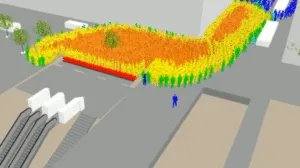
Simulation not only enhances the visitor experience but also improves safety. During the 2014 FIFA World Cup in Brazil, PTV Viswalk helped improve safety conditions at several stadiums where evacuation times exceeded international standards. At the iconic Maracanã Stadium, simulation revealed that exit ramps were too narrow to accommodate the expected pedestrian volume. Widening the ramps significantly improved pedestrian flow and evacuation performance. Additionally, solutions like PTV Flows complement simulation by providing real-time traffic monitoring and predictive analytics. By combining real-time and historical travel data, public authorities and traffic management centers can detect abnormal traffic patterns, predict congestion hotspots, and identify disruptions before they severely impact travelers. These insights enable operators to take proactive measures, such as adjusting signal timing, implementing traffic management plans, prioritizing public transit, or informing travelers of alternative routes. The combination of simulation and real-time travel intelligence helps cities move from planning potential scenarios to actively managing dynamic conditions during events. As the world prepares for the largest FIFA World Cup in history, one thing is clear: successful events increasingly depend on understanding how crowds move and how the entire transportation system performs under pressure.
This article is compiled by Wedoany. All AI citations must indicate the source as "Wedoany". If there is any infringement or other issues, please notify us promptly, and we will modify or delete it accordingly. Email: news@wedoany.com