en.Wedoany.com Reported - SSSTC, a solid-state drive supplier from Taiwan, China, showcased a portfolio of enterprise-grade SSDs designed for immersion cooling environments during COMPUTEX 2026 in Taipei on June 2. The product lineup covers SATA and PCIe U.2 series, primarily serving AI data centers, high-density computing, edge intelligence, and industrial deployment scenarios.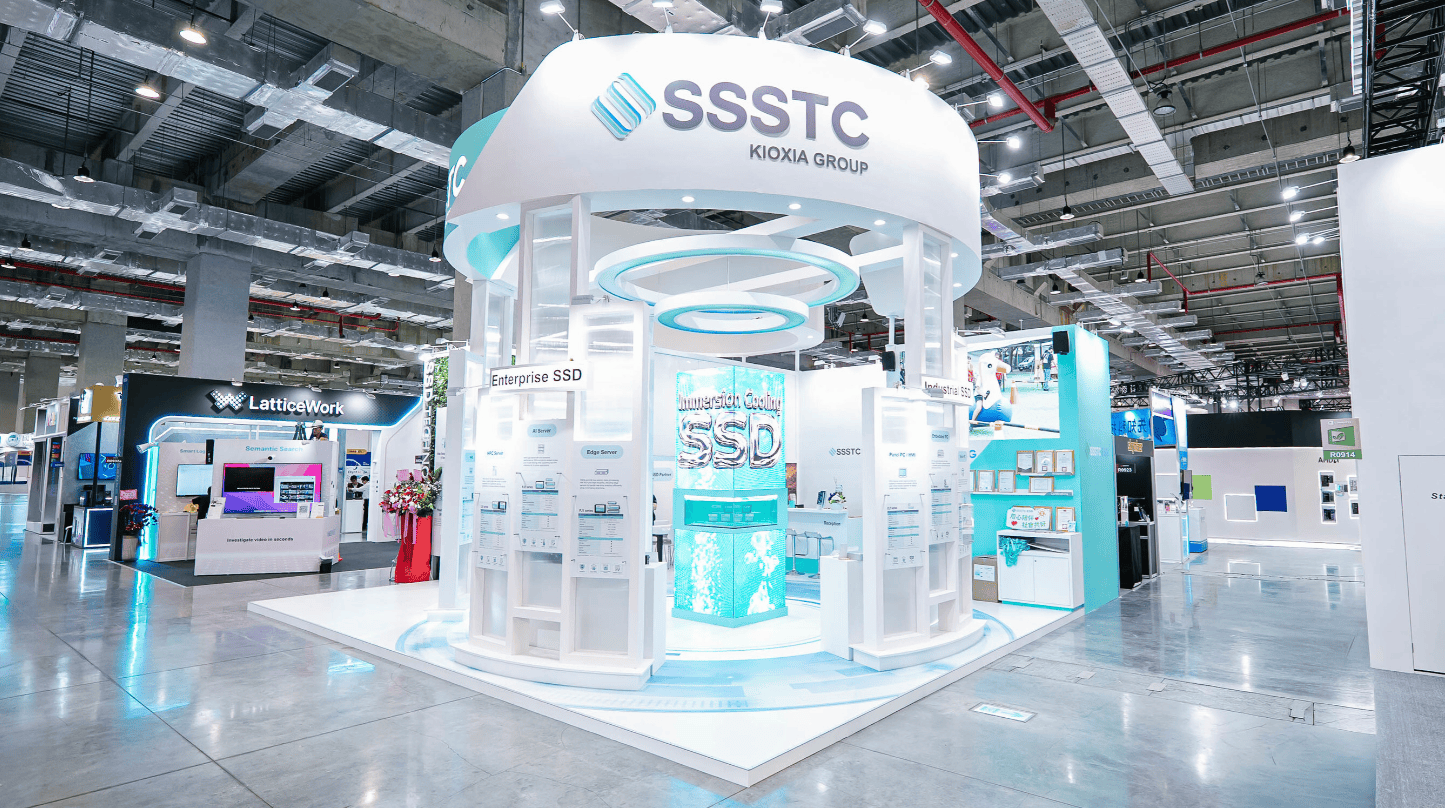
The portfolio showcased by SSSTC includes the SATA ER3, ER4, and ER5 series, as well as the PCIe U.2 PJ1 and EJ5 series, with optimizations in materials, structure, and component protection specifically for immersion cooling environments. Immersion cooling is a heat dissipation method increasingly adopted by high-density data centers, where servers, storage, and related electronic components are placed in non-conductive dielectric fluid. Heat is removed through fluid circulation and exchange, reducing the cooling bottlenecks faced by traditional air cooling in high-power rack scenarios. For SSDs, the challenges posed by immersion cooling environments extend beyond temperature changes to include the impact of dielectric fluids on long-term material stability, connector reliability, packaging structure, corrosion protection, and maintenance cycles. In its new products, SSSTC has enhanced corrosion-resistant design, component protection, and structural adaptation, indicating that storage devices have moved from merely "providing sufficient capacity and read/write performance" to a new phase of "ensuring long-term stable operation in liquid-cooled data centers." In addition to enterprise-grade products, the company also showcased industrial-grade SSDs for edge intelligence and harsh industrial environments, with an operating temperature range covering -40°C to 85°C, along with vibration and shock resistance, suitable for outdoor equipment, industrial computing, edge gateways, and field data acquisition nodes. The enterprise-grade eTLC SSDs offer two five-year endurance options of 1 DWPD and 3 DWPD for AI workloads, maintaining over 90% random IOPS consistency under sustained loads, and supporting denser data center storage scenarios through firmware optimization, low-latency capabilities, capacitor-based power loss protection, and immersion cooling support.
Founded in 2008, SSSTC became a subsidiary of Japan's Kioxia in 2020, and has long focused on R&D in SSD firmware, NAND applications, and enterprise-grade storage customization capabilities.
Hardware upgrades in AI data centers are extending from computing chips, switching networks, and power systems down to the storage device layer. Large model training, vector databases, real-time inference, retrieval-augmented generation, multimodal content processing, and data lake analysis all impose requirements for high-frequency read/write, sustained writes, low-latency access, and greater stability. Traditional air-cooled data centers have matured in the general cloud computing era, but when faced with higher power density AI servers and accelerator racks, air cooling systems encounter multiple limitations in airflow design, floor space, noise, energy consumption, and hotspot management. Immersion cooling can improve heat dissipation efficiency, enhance power usage effectiveness, and enable higher-density server and storage deployments, but this also requires synchronized adaptation of hard drives, motherboards, power supplies, cables, connectors, and maintenance procedures. SSDs in AI data centers handle tasks such as model data loading, training sample reading, log writing, checkpoint saving, inference caching, and edge data backhaul. If they suffer from corrosion, performance fluctuations, or inadequate power loss protection in liquid-cooled environments, cluster stability can be directly impacted. SSSTC emphasizes a multi-layer power loss protection framework, including hardware power loss protection, firmware power loss protection, and PLN mechanisms, while also offering configurable over-provisioning, lifespan and capacity optimization, performance and power tuning, and application-specific firmware development. These capabilities help data center customers customize storage solutions based on AI workload characteristics and deployment environments. As liquid-cooled servers gradually enter volume procurement cycles, immersion-cooled SSDs will become a critical component in the transition from rack-level design to full-chain liquid cooling adaptation in AI data centers.
This product launch also reflects the storage industry's re-entry into the core of data center infrastructure competition. In the past, enterprise SSDs competed primarily around capacity, interface speed, endurance, and cost. In AI data center scenarios, storage devices must also simultaneously meet requirements for cooling methods, energy management, sustained load consistency, power loss protection, and on-site operational reliability. Future variables will focus on immersion cooling medium compatibility, long-term reliability validation, mainstream server vendor certification, the pace of volume adoption by data center customers, and the construction costs of liquid-cooled racks in different regions. If liquid-cooled data centers continue to expand deployment, SSD manufacturers will need to integrate materials engineering, firmware capabilities, and system thermal adaptation into their core product competition strategies.
This article is compiled by Wedoany. All AI citations must indicate the source as "Wedoany". If there is any infringement or other issues, please notify us promptly, and we will modify or delete it accordingly. Email: news@wedoany.com