en.Wedoany.com Reported - The Alliance for European Flax-Linen & Hemp emphasizes the potential of organic fibers such as flax and hemp in composite 3D printing. Unlike composites typically reinforced with carbon or glass fibers, the development of flax and hemp biocomposites in additive manufacturing has been driven by several key technologies.
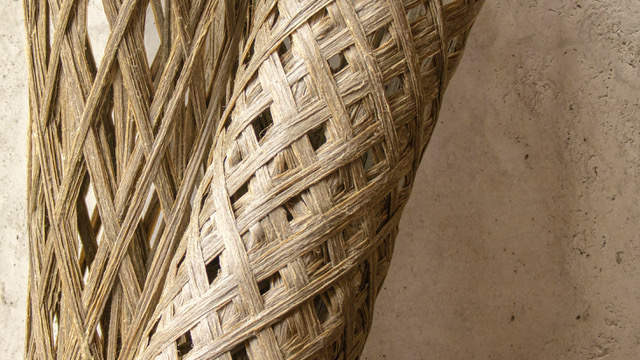
One such process is coreless filament winding, a robotic manufacturing technique that winds resin-impregnated flax fibers into 3D structures, enabling the creation of large-scale, complex, and structurally optimized geometries without the need for molds. In the FIBRAS project at Eindhoven University of Technology, the research team used commercial short-fiber flax rovings for coreless filament winding to develop large-scale architectural lattice structures that are both strong, lightweight, and resource-efficient.
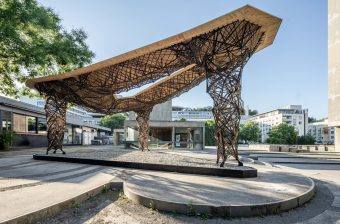
Another architectural process innovation is the "Con[knit]uous Rubble" technology developed by the ICD/ITKE at the University of Stuttgart. This technique relies on continuous circular knitting to wrap untreated construction waste in seamless flax fiber structures, creating self-supporting arches and columns without the need for adhesives or mortar. The process is supported by flax and hemp spinner Safilin.
For biocomposite applications specifically in additive manufacturing, continuous flax fiber-reinforced printing processes co-extrude flax yarns with thermoplastics such as PLA, producing composite components whose performance is already comparable to traditional composite parts. Additionally, commercially available composite flax fiber filaments can be used on standard extrusion platforms to produce biocomposite components.
French designer Alyssa Cartaut uses such 3D-printed composites in her work. Her "The Cushion Issue" footwear collection is made using 3D printing and PLA filaments reinforced with European flax fibers. Multiple components, including heels and insoles, are crafted from flax composites, offering a bio-based alternative to traditional materials such as resins or plastics.
Research is also underway in the field of 4D printing. Professor Antoine le Duigou at the Institut de Recherche Dupuy de Lôme is exploring the use of these natural fiber composites to create structures that respond to stimuli such as heat or moisture. Bruno Pech of the Alliance for European Flax-Linen & Hemp stated that European flax and hemp are redefining the possibilities of biocomposite manufacturing, entering highly automated processes such as filament winding, prepreg systems, and additive manufacturing, with natural fibers now suitable for the most advanced industrial applications.
This article is compiled by Wedoany. All AI citations must indicate the source as "Wedoany". If there is any infringement or other issues, please notify us promptly, and we will modify or delete it accordingly. Email: news@wedoany.com