en.Wedoany.com Reported - Infineon Technologies AG has integrated the OPTIGA™ Trusted Platform Module (TPM) SLB 9672 into NVIDIA's Jetson Thor processing platform. This hardware module isolates cryptographic assets at the silicon level and monitors system state parameters, providing a certified root of trust for robotics and physical AI systems. This architecture offers cryptographic verification mechanisms for robot fleet operators, preventing software tampering when autonomous machines enter factory, medical facility, and public infrastructure spaces.
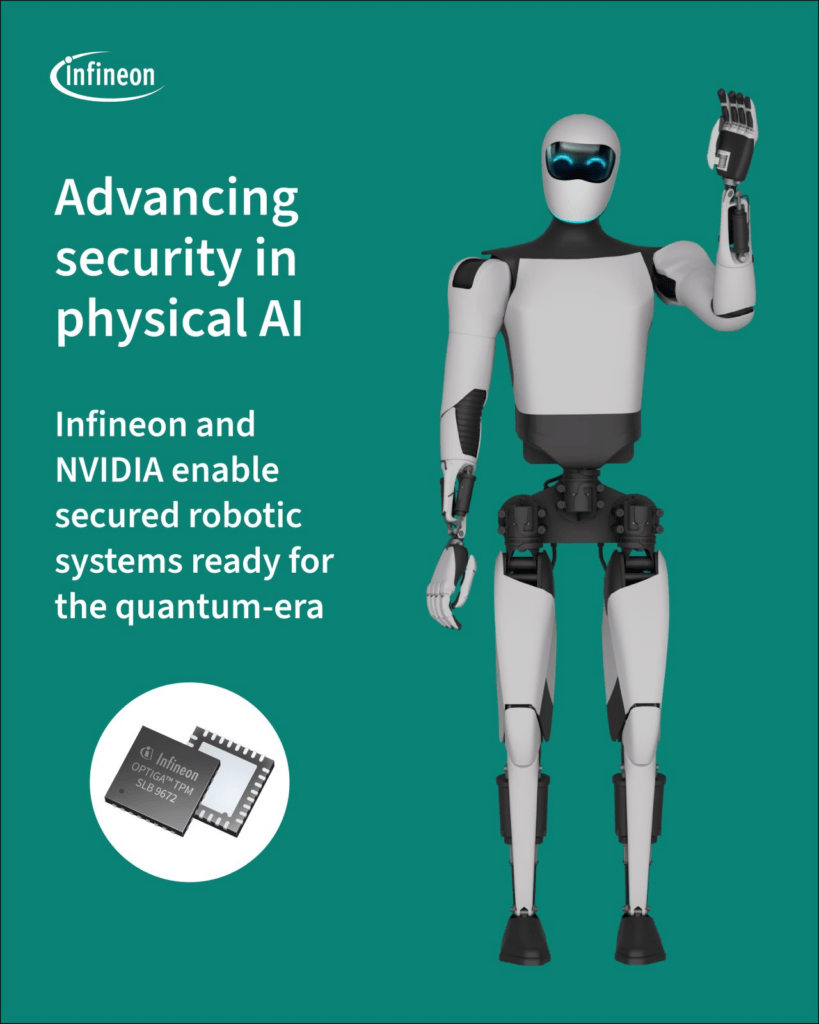
This integrated solution pairs NVIDIA's robotics and edge AI processor with a physically isolated security controller to circumvent vulnerabilities in software-defined isolation barriers on the main application unit. The OPTIGA TPM, functioning as an autonomous cryptographic vault and certified under FIPS and Common Criteria standards, protects configuration files and manages secure code execution loops through hardware-enforced protection. The platform generates cryptographic hashes of the operating system and AI model weights during startup, enabling remote monitoring consoles to verify that the runtime software stack has not been modified. The module employs a firmware update mechanism protected by post-quantum cryptography (PQC), safeguarding device root privileges against future quantum decryption vectors. For long-term quantum resistance, the hardware roadmap embeds algorithms standardized by the National Institute of Standards and Technology (NIST), using ML-KEM for key exchange and ML-DSA for digital signatures, thereby protecting over-the-air (OTA) updates and local neural network weights from cryptographic threats.
The deployment of chip-level security architecture is driven by evolving international regulatory requirements, including the EU Cyber Resilience Act, the EU AI Act, and industrial manufacturing standards such as IEC 62443, which mandate hardware-verifiable security attestations throughout the device lifecycle. By embedding a hardware-based root of trust in the early design phase, manufacturers can ensure that deployed robot fleets meet auditable compliance requirements when regulations take effect, without the need for physical hardware modifications. This partnership, led by Dr. Stephan Zizala, President of a division at Infineon, and Deepu Talla, Vice President at NVIDIA, targets the humanoid robot and industrial automation system markets. Considering that the semiconductor content per humanoid robot in power, sensing, and drive modules is estimated at approximately $500, the growing share of dedicated security hardware in the overall bill of materials is transforming edge AI prototypes into verified commercial fleet operations.
This article is compiled by Wedoany. All AI citations must indicate the source as "Wedoany". If there is any infringement or other issues, please notify us promptly, and we will modify or delete it accordingly. Email: news@wedoany.com