en.Wedoany.com Reported - European chip design company SiPearl has taped out its first processor, Rhea1, and completed a €130 million Series A funding round, while also planning to launch a €200 million Series B round to accelerate its product roadmap. Headquartered in Maisons-Laffitte, France, the company's Rhea1 processor is designed to power Jupiter, Europe's first exascale supercomputer.
Ian Jenks, Chairman of the Board of SiPearl, stated at a press conference in Paris that Europe has not brought an independent CPU to market in over 40 years, and the tape-out of Rhea1 is the first step in reversing this trend. He emphasized that this is a matter of security and independence, given Europe's inability to rely on American hardware for processing strategic data.
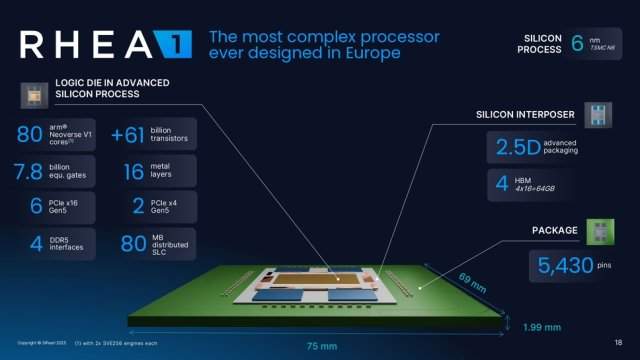
Although Rhea1 is manufactured using TSMC's 6nm process and is not 100% proprietary, SiPearl owns its code and is aware of its internal details. The processor targets high-performance computing, data centers, artificial intelligence, and critical sectors such as defense, security, and medical research. Philippe Notton, CEO and founder of SiPearl, pointed out that computing has become a fundamental asset, but also a source of potential conflict and export controls.
Rhea1 is specifically developed for HPC and AI inference workloads. Its 2.5D integrated package contains over 61 billion transistors, including 80 Arm Neoverse V1 cores, each equipped with two 256-bit SVE units, and four HBM stacks of high-bandwidth memory totaling over 64 GB. Notton stated that this means an entire large language model can be stored on the chip without external memory. Rhea1 will be available for sampling in early 2026, compatible with any third-party accelerator, and supported by a wide range of software from C/C++ to TensorFlow.
Subsequent products, Rhea2 and Rhea3, will be deployed in 2027 and 2028 respectively, adopting a chiplet-based architecture and targeting the data center market. Notton revealed that Rhea2 and Rhea3 will feature approximately 192 cores, surpassing Arm's Neoverse V3 cores. Regarding the instruction set architecture choice, Notton explained that Arm was chosen for the first few generations because RISC-V is not yet mature for HPC and data centers, and Arm manages patents and guarantees legal protection. He believes that for Europe to achieve true autonomy, it needs to develop its own system, such as a RISC-VI, created from scratch to avoid any dependencies.
In terms of financing, SiPearl was incubated by the European Investment Bank in 2018 and received a total of €7.4 million in grants from Horizon 2020 in its early stages. The Series A round totaled €130 million, completed in three tranches: a first tranche of €90 million in April 2023 (including up to €25 million in convertible bonds from the European Investment Bank), a second tranche of €23 million in December 2024 (including €15 million in equity and €8 million in blank loans), and a third tranche of €32 million, with investors including the EIC, the French government, and Taipei-based private equity firm Cathay Venture. Notton acknowledged that financing for semiconductor startups in Europe remains difficult, and the costs of using TSMC foundry services and EDA tools are high, with the first platform costing over €200 million. The company plans to officially launch its Series B round in early 2026, aiming to raise €200 million to implement its roadmap from 2026 to 2028. Jean-Luc Gilbert, CFO of SiPearl, stated that the company plans to conduct an initial public offering, but not before 2027.
Notton admitted that the company has gone through difficult times, entering a mediation phase this past winter, with development taking longer than expected, leading to unexpected expenses and several months of delays. The entire process was a decisive moment, and the company ultimately emerged relatively unscathed.
In the supercomputer field, according to the latest TOP500 list, Europe has five supercomputers in the top ten. Jupiter is SiPearl's first design win, operated by the Jülich Supercomputing Centre, with a computing performance of 1 exaflop FP64 per second. Its cluster module includes over 1,300 nodes equipped with Rhea1 processors. Additionally, SiPearl is participating in EU collaborative research and innovation projects such as the European Processor Initiative, Aero Project, Excellerat, Odissee, OpenCube-EU, MaX, Emopass, Plasma-Pepsc, Riser, and Higher.
This article is compiled by Wedoany. All AI citations must indicate the source as "Wedoany". If there is any infringement or other issues, please notify us promptly, and we will modify or delete it accordingly. Email: news@wedoany.com