en.Wedoany.com Reported - On June 2, Forbes' real-time billionaires list showed that SoftBank Group founder and CEO Masayoshi Son's personal assets reached $100.7 billion, surpassing Indian billionaires like Mukesh Ambani and Gautam Adani to become Asia's richest person for the first time in over a decade.
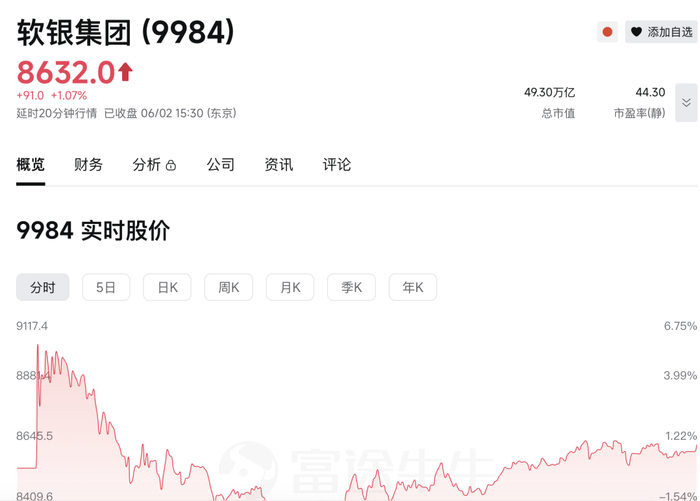
SoftBank's stock price surged as much as 14.71% during trading on June 1, pushing its market capitalization to 48 trillion yen (approximately $306 billion), overtaking Toyota's market cap of around 46 trillion yen and ending the latter's more than two-decade reign as Japan's most valuable listed company. By the close of Tokyo trading on June 2, SoftBank's market cap had further risen to 49.30 trillion yen, while Toyota stood at 44.92 trillion yen.
At the "Choose France" investment summit held in Paris on Monday, Son announced a total investment plan of 75 billion euros for an AI data center. The initial phase of the plan involves 45 billion euros in investment, aiming to build 3.1 gigawatts of computing capacity by 2031, with potential expansion to 5 gigawatts. This project served as a direct catalyst for the rise in SoftBank's valuation and the growth of Son's personal wealth.
SoftBank stated that the initial sites are located in Dunkirk, Bosquel, and Bouchain in the Hauts-de-France region of northern France, with partners including Électricité de France (EDF) and Schneider Electric. The project will leverage France's low-cost nuclear power to address the high energy consumption of computing. This marks SoftBank's largest single AI investment in Europe, aside from its Stargate computing project in the United States.
In recent years, Son has been continuously building a full AI industry chain layout, covering large models, mid-range general-purpose computing chips, and underlying data center infrastructure. On the AI application front, SoftBank has invested over $64 billion in OpenAI, acquiring approximately 13% equity, making it the second-largest external shareholder after Microsoft. Driven by the significant increase in the value of its OpenAI investment, SoftBank's Vision Fund achieved $46 billion in investment gains in fiscal year 2025, with approximately $20 billion earned in the fourth quarter alone—almost entirely from its investment in OpenAI. In the general-purpose computing chip sector, SoftBank announced in March 2025 the acquisition of U.S.-based Ampere Computing for $6.5 billion in an all-cash deal. Founded by former Intel executives, the company primarily produces high-performance, low-power data center CPUs based on the Arm architecture, with products already supplied in bulk to Amazon AWS and Microsoft Azure. Upon completion of the acquisition, the company can create synergies with SoftBank's Arm in chip IP and terminal processors, filling SoftBank's gaps in cloud-based general-purpose computing. In terms of underlying self-developed hardware, Arm officially released its AGI architecture CPU for general artificial intelligence in March this year. Leveraging Arm's dominant position in over 90% of global mobile terminal IP licensing, the company has rapidly entered the cloud-based AI chip market, becoming a key factor for capital markets' optimism about SoftBank's long-term value. Additionally, SoftBank, together with OpenAI and Oracle, is advancing the $500 billion U.S. Stargate supercomputing project, achieving a dual-line layout of computing infrastructure in both Europe and the United States.
This is not the first time Son has claimed the title of Asia's richest person. In 2014, when Alibaba went public on the U.S. stock market, SoftBank's early equity investment yielded substantial returns, pushing Son's personal net worth to $16.6 billion, making him Japan's richest person. Subsequently, due to significant losses from Vision Fund investments in WeWork, ride-hailing, and other projects, coupled with a pullback in Alibaba's stock price, Son's wealth shrank considerably for several consecutive years, often being surpassed by Uniqlo founder Tadashi Yanai and a host of Indian industrial tycoons. The current wealth growth is entirely driven by the revaluation of the AI industry. Son holds approximately 33.74% of SoftBank's equity, and the single-day surge in SoftBank's stock price on June 1 alone increased his personal wealth by over $12 billion. SoftBank's full-year results for fiscal year 2025, disclosed in May, showed net profit attributable to the parent company reaching 550.8 billion yen, a year-on-year increase of 4.7%, setting a new annual net profit record since the company's founding and significantly exceeding the internal performance guidance of 543 billion yen.
SoftBank is also advancing the divestiture of non-core assets, gradually reducing its holdings in T-Mobile and some of its remaining Alibaba shares, freeing up tens of billions of dollars to invest entirely in the AI sector. Company management stated during the earnings call that over 80% of capital expenditures over the next three years will focus on AI infrastructure and chip research and development. In its medium-term business plan, SoftBank has set a target of achieving 1.7 trillion yen in operating profit by fiscal year 2031, a goal entirely dependent on the realization of the AI ecosystem. At SoftBank's 2025 annual general meeting, Son announced the group's long-term goal to all shareholders: transforming SoftBank into a leading global platform in the field of super artificial intelligence (ASI) over the next decade, benchmarking against the platform ecosystems of Microsoft, Google, and Amazon, and firmly betting on the entire general AI industry chain. Son has predicted that by 2035, the intelligence of super AI will surpass that of humans by 10,000 times, requiring 200 million high-end chips, $9 trillion in capital investment, and 400 gigawatts (GW) of supporting electricity to realize the super AI industry—this serves as the theoretical basis for his continued investment in computing power, data centers, and chip companies.
SoftBank's market cap surpassing Toyota is a microcosm of the evolving logic of industrial value in Japan's capital market. Toyota, as a global benchmark in the automotive industry, has long held the top spot in Japan's market capitalization due to its hybrid technology and global production and sales system, with market funds consistently favoring its stable manufacturing cash flow. However, by 2026, global capital trends have fully shifted toward computing power and AI infrastructure, leading to a significant valuation surge for SoftBank. On June 1, Toyota's stock price fell by 4.37%, as slowing global demand for passenger vehicles and increasing investment in new energy transformation further suppressed the automaker's valuation. Amid this rise and fall, Japan's stock market witnessed a change in its leading company.
This article is compiled by Wedoany. All AI citations must indicate the source as "Wedoany". If there is any infringement or other issues, please notify us promptly, and we will modify or delete it accordingly. Email: news@wedoany.com