First Steel Truss Girder Successfully Erected for South Navigational Channel Bridge of China's Hangzhou Bay Sea-Crossing Railway Bridge
en.Wedoany.com Reported - On June 4, at the construction site of the Hangzhou Bay Sea-Crossing Railway Bridge, approximately 15 kilometers offshore from the Cixi side of the bay, a giant steel truss girder measuring 84 meters in length, 15 meters in width, 14 meters in height, and weighing 1,291 tons was precisely lifted and securely placed between the No. 160 main tower and the temporary girder erection support. Following the girder erection of the North Navigational Channel Bridge, Central Navigational Channel Bridge, and the offshore approach bridge, the successful installation of the first steel truss girder for the South Navigational Channel Bridge marks the project's full transition into the new phase of upper main structure construction.
As a key control project of the Nantong–Ningbo High-Speed Railway (referred to as the "Tongyong High-Speed Railway"), the bridge is located upstream of the existing Hangzhou Bay Sea-Crossing Highway Bridge. With a total length of 29.2 kilometers, it is currently the world's longest sea-crossing railway bridge under construction. It consists of three navigational channel bridges (north, central, and south) and a 26-kilometer-long offshore approach bridge along with a shoal area approach bridge. Designed with a double-track ballastless track system for speeds of 350 km/h, it is a super-long-span high-speed railway bridge cluster project.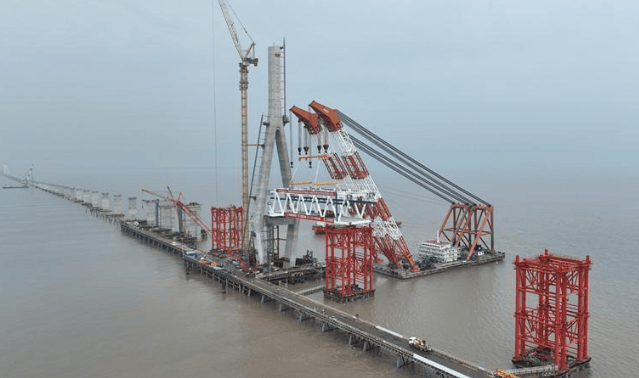
Among them, the South Navigational Channel Bridge features a main span of 364 meters and a total length of 814.5 meters, capable of accommodating navigation for 3,000-ton vessels. The bridge structure includes two diamond-shaped reinforced concrete main towers, each 157.5 meters high. The No. 160 main tower was topped out on May 6, while the No. 159 main tower is currently undergoing upper tower column construction.
The steel truss girder hoisted this time is the S1 segment of the southern mid-span of the South Navigational Channel Bridge. It adopts an integrated construction scheme of "overall manufacturing of large segments in the factory, transportation to the bridge site by ship, and overall erection by a large floating crane." Hangzhou Bay is one of the world's three major strong tidal bays, with an average of approximately 180 days of winds above Force 6 per year and a maximum tidal range of nearly 9 meters. The complex marine environment poses severe challenges to bridge construction.
In response, the project team optimized construction techniques and innovatively adopted a large-segment overall erection scheme. Temporary girder erection supports and pier-side bracing systems were pre-installed in the offshore work area, combined with a digital adjustment system using walking-type jacks, achieving millimeter-level precise alignment of the steel truss girder segments.
Meanwhile, the project's Smart Bridge Command Center, leveraging the BeiDou Navigation Satellite System, implements round-the-clock dynamic management of over 30 construction vessels at sea. By integrating real-time meteorological and hydrological data, electronic work zones are delineated to ensure safe and orderly hoisting operations.
According to Jing Xuefeng, head of the South Navigational Channel Bridge section of CCCC Second Harbor Engineering Co., Ltd., the steel truss girder of the South Navigational Channel Bridge is divided into 29 segments with a total weight of approximately 10,673 tons. All steel girder segments are manufactured and assembled in specialized steel girder workshops, optimized into 10 super-large segments, and then transported by ship to the construction site. The overall hoisting operation is carried out by the 2,200-ton large floating crane "Qin Hang Gong 1." A composite connection process combining welding and high-strength bolts is used between segments.
It is reported that the Tongyong High-Speed Railway is an important component of the "Eight Vertical and Eight Horizontal" high-speed railway network's coastal corridor. Starting from Nantong West Station on the Yancheng–Nantong High-Speed Railway, it runs southward through Suzhou City in Jiangsu Province, Jiaxing City and Ningbo City in Zhejiang Province, and connects to Ningbo Station in the Ningbo hub. The new line has a length of 301 kilometers, a design speed of 350 km/h, and includes 10 stations along the entire route.
Once completed, the project will connect with multiple railway lines, playing a positive role in building a "rail-based Yangtze River Delta," improving the regional rail network layout, facilitating travel for residents along the route, and promoting the high-quality integrated development of the Yangtze River Delta.
This article is compiled by Wedoany.com. AI citations must indicate the source "Wedoany.com." For any copyright issues or other concerns, please notify us promptly, and we will make corrections or deletions. Email: news@wedoany.com
Related Products
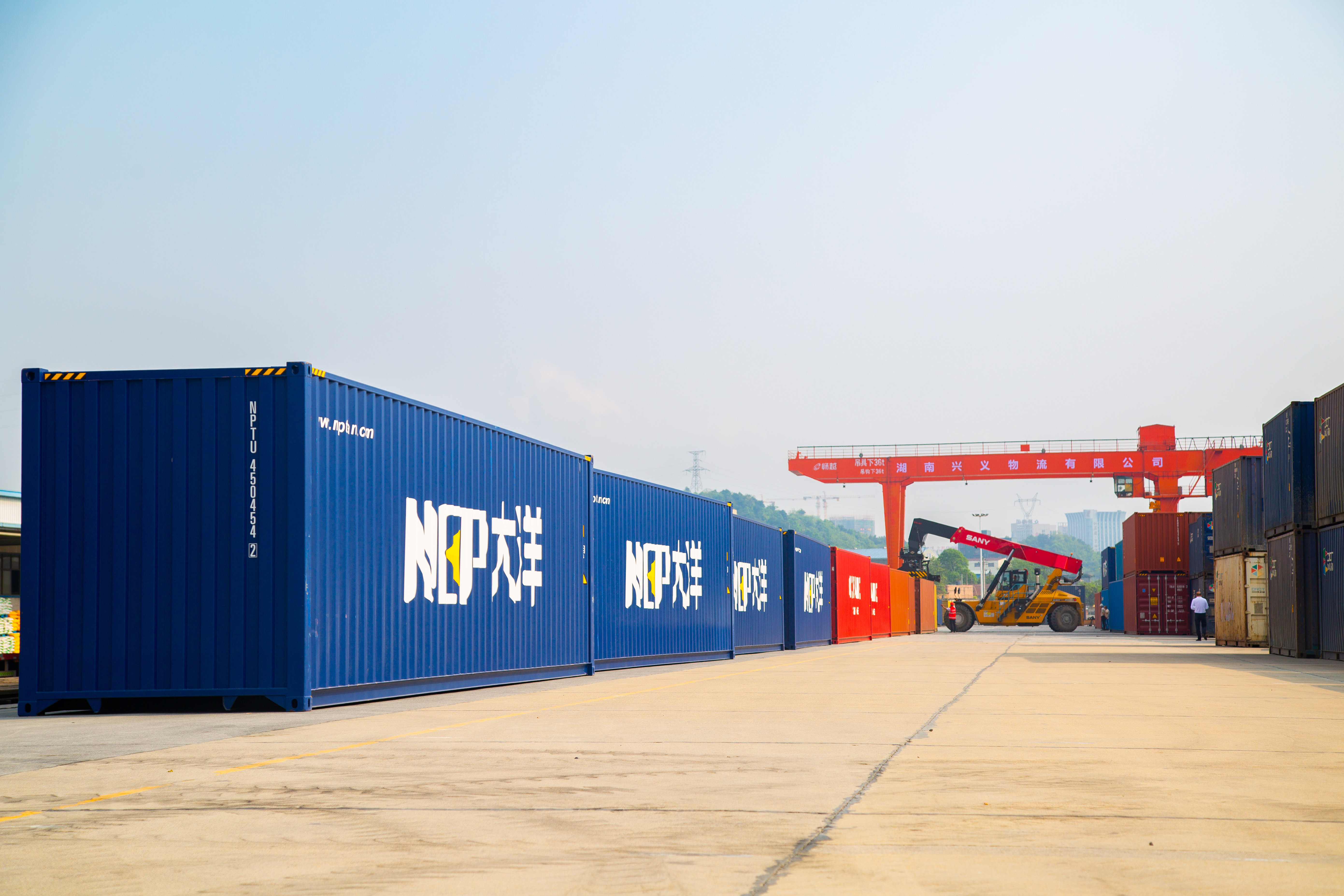

China - Alashankou/Khorgos - Europe Full Range Transportation (Mala/Hamburg/Duisburg/Budapest, etc.)
Shenzhen Neptune Logistics Co., Ltd.

Industrial and Commercial Point-Type Gas Detector
Jinan Benan Technology Development Co., Ltd.![IVECO Cash-in-Transit [DMT5048XYCL3-AM] - Chongqing Dima Industry Co., Ltd](https://img.wedoany.com/2026/0911/20260911030157582.png)

GSR6-27.5kV SF6 Free Gas-insulated Metal-enclosed Switchgear
Zhejiang Juhonkia Intelligent Electric Co., Ltd.