53rd Uruguayan Bovine Congress Opens
en.Wedoany.com Reported - The 53rd Uruguayan Bovine Congress (Jornadas Uruguayas de Buiatría) opened on June 4 in Paysandú, with the interim Minister of Livestock, Agriculture and Fisheries, Matías Carámbula, presiding over the opening ceremony. He was accompanied by Jorge Carluccio, President of the National Academy of Veterinary Medicine (Academia Nacional de Veterinaria); José Passarini, Dean of the Faculty of Veterinary Medicine (Facultad de Veterinaria); Daniel Gilardoni, President of the Uruguayan Society of Veterinary Medicine (Sociedad de Medicina Veterinaria del Uruguay); Gabriela Gómez, Secretary General of the Paysandú Departmental Government; Carmela Dos Santos, President of the Paysandú Veterinary Medical Center (Centro Médico Veterinario de Paysandú); Cecilia Bonino, President of the Uruguayan Veterinary College (Colegio Veterinario del Uruguay); and Lourdes Adrien, Chair of the Congress Organizing Committee.
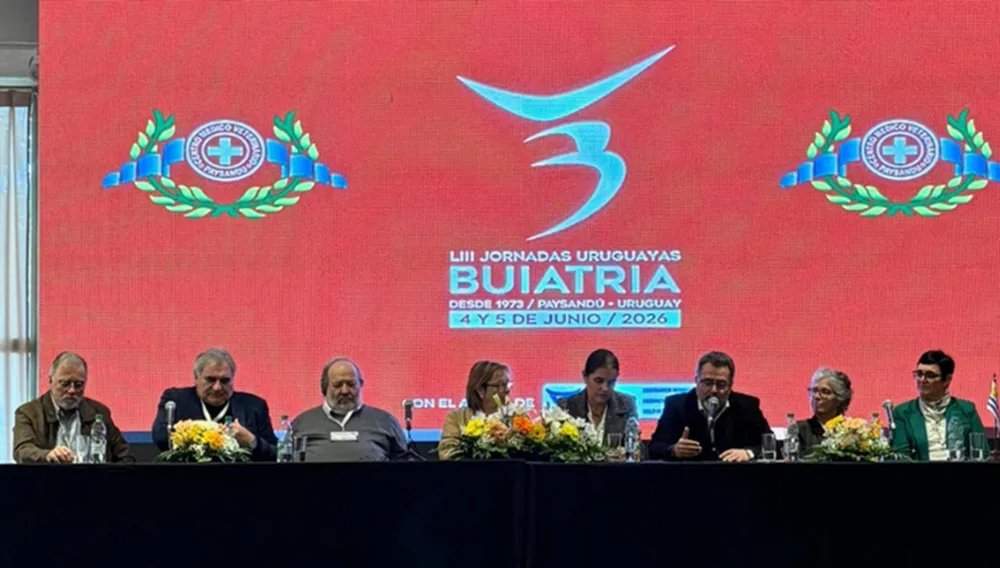
In his speech, Carámbula emphasized that the Congress carries a historical legacy and holds contemporary relevance in the face of current health challenges. He noted that the sector faces issues such as ticks and screw-worm flies, and that this is an opportunity to highlight the industry's contribution to national health. Carámbula stated that major health programs require a comprehensive approach and multi-stakeholder participation to achieve sustainable results, citing examples such as tick control programs or screw-worm fly eradication plans, which cannot be achieved through a single measure but must be fully integrated. He also underscored the role of science, technology, and innovation in national health policies, as well as the coordination between the Ministry of Livestock, Agriculture and Fisheries and universities, research centers, and public-private institutions. Carámbula pointed out that health controls are crucial for market access and food exports, and that the official laboratory network should be strengthened. He reaffirmed the importance of the "One Health" (Una Salud) concept as a guiding principle for public health policies, arguing that animal health, environmental health, and human health are interconnected, and that integrating these three dimensions into policies is an ongoing challenge for the sector.
The Congress spans two days (Thursday and Friday), with an agenda including conferences, roundtable discussions, and scientific reports on animal health, production, innovation, and applied technologies in the livestock industry. On Saturday, June 6, a practical workshop will be held at the facilities of the Agricultural College (Eemac), featuring the participation of Dr. Germán Cantón, a researcher from the Balcarce branch of the National Institute of Agricultural Technology (Instituto Nacional de Tecnología Agropecuaria, INTA).
This article is compiled by Wedoany. All AI citations must indicate the source as "Wedoany". If there is any infringement or other issues, please notify us promptly, and we will modify or delete it accordingly. Email: news@wedoany.com
Related Products




714CD Series C-Band Weather Radar
Chengdu Zhongdian Jinjiang Information Industry Co., Ltd.
4HS-8 High-efficiency Peanut Inverted-laying Harvester
Hebei Yongfa Hongtian Agricultural Machinery Manufacturing Co., Ltd.

Industrial and Commercial Point-Type Gas Detector
Jinan Benan Technology Development Co., Ltd.