en.Wedoany.com Reported - Mexico is welcoming the 2026 FIFA World Cup with a series of infrastructure projects that are either completed or in their final stages, focusing on improving mobility, transportation, connectivity, and urban spaces to leave a lasting legacy for its three host cities. Mexico City, Monterrey, and Guadalajara are the primary areas of intervention, while the tournament's social impact extends to municipalities nationwide through the construction and renovation of community sports fields.
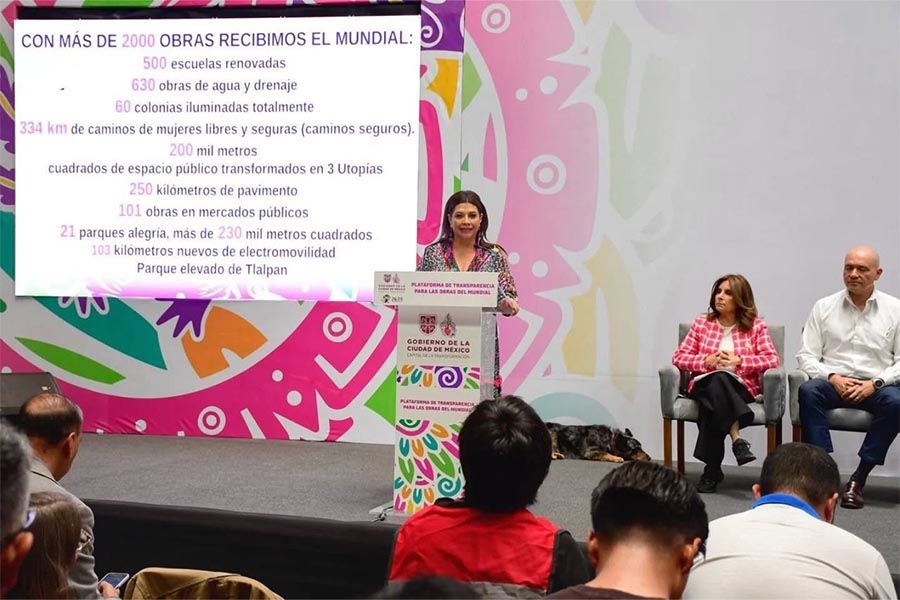
Mexico City is the main focus of World Cup-related investment. The capital's government reports that projects linked to the tournament amount to 23.122 billion pesos ($1.3 billion), part of a portfolio of over 2,000 completed or ongoing projects. Head of Government Clara Brugada introduced the 2026 World Cup Project Transparency Platform, a digital tool allowing users to query project progress, investment amounts, funding sources, and photographic evidence. Brugada stated that the capital has not allocated resources to temporary infrastructure, with all investments directed toward projects that will remain after the tournament and improve the lives of millions.
The transparency platform, launched on June 1, will gradually update information on over 2,000 projects carried out in the capital, aiming to provide an interactive portal for monitoring public resource use and making investments in mobility, water, transportation, security, public spaces, and urban equipment more transparent. According to the capital's Secretary of Administration and Finance, Juan Pablo de Botton, of the total 23.122 billion pesos, 7 billion are allocated to water infrastructure; 5.764 billion to mobility and public transportation, including the Metro, light rail, trolleybuses, and the addition of 17 new light rail cars; and 2.6 billion to the road resurfacing program. Projects also include 250 kilometers of resurfaced roads (equivalent to 3.5 million square meters), 334 kilometers of lighting on safe routes, 634 water supply and drainage projects, 316 sports field renovations, comprehensive improvements to 500 public schools, interventions in 104 public markets, and over 100 kilometers of electric transportation infrastructure.
In terms of urban mobility, Mexico City completed the modernization of the "Ajolote" Light Rail (Taxqueña-Xochimilco Light Rail) with an investment of 2.4 billion pesos. Another 2.4 billion pesos were allocated to the Metro (Sistema de Transporte Colectivo Metro), with 1.6 billion for comprehensive maintenance and 833 million for the renovation of 20 stations. The city also reported over 100 kilometers of electric transportation infrastructure, including the "Route Zero" or "Chapulín Route" connecting Chapultepec Metro station to University City, and the Universidad-Huipulco route. Projects also include the modernization of the Huipulco and Tasqueña transfer centers, restoration of the Xochimilco dock, renovation of the Pink Zone, remodeling of Tlalpan Avenue, and the construction of an elevated park above that avenue. In road infrastructure, the capital's government reported paving over 250 linear kilometers of roads with an investment exceeding 2.6 billion pesos.
One of the most significant federal projects is the first phase of the Mexico City International Airport renovation, with an investment of 6.5 billion pesos. Work includes terminal remodeling, operational improvements, and measures to streamline passenger and aircraft movement during the tournament. The federal government also highlighted the inauguration of the "Felipe Ángeles" train on the Buenavista-AIFA segment, featuring 7 stations and 4 trains with departures every 30 minutes, aimed at strengthening airport connectivity in the metropolitan area. Key airports including Guadalajara, Monterrey, Cancún, AIFA, and AICM have conducted drills and site visits to test procedures for sports delegation entry, security, and services. According to Gabriela Cuevas, the federal government's coordinator for the 2026 World Cup, during the March playoffs, entry processing times in Guadalajara ranged between 20 and 25 minutes, and in Monterrey, 15 minutes.
In Monterrey, World Cup preparations focus on enhancing metropolitan mobility and urban connectivity. Nuevo León has accelerated the construction of new Metro Lines 4 and 6 and added new urban transport units to meet expected demand during the tournament and increase system capacity. The Monterrey Stadium ("Steel Giant") has completed specific adjustments required by FIFA, primarily concerning pitch quality, high-speed internal connectivity, and hospitality areas. The city's international airport was also part of federal pre-operational exercises.
Guadalajara has concentrated efforts on urban renewal, road connectivity, and sports facility upgrades. Key interventions include renovating the Minerva Roundabout (featuring safer crosswalks) and paving the Chapala Highway corridor leading to the airport. The Guadalajara Stadium (Akron Stadium) has met FIFA requirements regarding connectivity, pitch, and hospitality areas. The city was used as an operational test venue during the intercontinental playoffs.
Beyond the World Cup host venues, the federal government promotes the "Mexico 2026 Social World Cup" program as a strategy to leave sports infrastructure in communities nationwide. President Claudia Sheinbaum stated that the goal is to leverage the tournament to strengthen physical activity. The program includes the construction and renovation of 4,208 sports fields nationwide, coordinated by federal agencies, states, and municipal governments. The Secretariat of Agrarian, Territorial and Urban Development is executing 1,200 fields, including 799 new constructions and 401 renovations, with a budget of 2 billion pesos, distributed across 31 entities and over 500 municipalities.
According to federal information, federal entities are responsible for 2,174 renovated fields, with other agencies adding further interventions. The Ministry of Tourism includes 86 soccer fields in host states; the Ministry of Welfare reports 448; the Secretariat of Agrarian, Territorial and Urban Development reports 1,200; states report 2,174; and IMSS reports 50. By state breakdown, Nuevo León stands out with 515 renovated fields, Mexico City with 455, and Jalisco with 101. The program also includes the creation of World Cup-themed murals, with entities reporting 1,326 in progress or completed, while Imjuve coordinates an additional 4,645, totaling 5,971 interventions.
The Mexican government's bet is that the World Cup will act as a catalyst for public and private investment in permanent infrastructure. In Mexico City, the focus is on mobility, water, public transportation, road resurfacing, urban spaces, and security; in Monterrey, the priority is expanding public transportation; in Guadalajara, projects center on urban renewal and road connectivity. The challenge will be ensuring projects continue to operate and are properly maintained after the tournament concludes. Currently, the 2026 World Cup Project Transparency Platform serves as the primary mechanism for public oversight of the investment portfolio, which in the capital alone exceeds 23.122 billion pesos. Brugada stated, "We will enjoy the World Cup, we are ready to host it, it will be remembered, but the projects will remain."
This article is compiled by Wedoany. All AI citations must indicate the source as "Wedoany". If there is any infringement or other issues, please notify us promptly, and we will modify or delete it accordingly. Email: news@wedoany.com