en.Wedoany.com Reported - A research team at Seoul National University has developed a new class of ultra-lightweight structural materials by constructing mesoscale carbon fiber lattices through a manufacturing method called 3D node winding. These lattices achieve a strength-to-weight ratio comparable to aluminum but weigh only one-hundredth as much. The findings, published in Nature Communications, demonstrate a novel approach to building strong, lightweight structures without the need for joints or layered assembly, eliminating a key bottleneck in designing complex three-dimensional forms from discrete components.
High-strength, lightweight materials are critical for applications such as drones, robotics, vehicles, and aerospace systems. Traditional carbon fiber composites, while offering excellent strength-to-weight ratios, are typically made by layering or assembling multiple parts, which limits design flexibility and creates weak interfaces. Advanced 3D-printed composites also rely on layer-by-layer fabrication, introducing internal boundaries that hinder load transfer, forcing designers to compromise between structural complexity and mechanical reliability.
Instead of assembling or stacking materials, the research team places a single continuous carbon fiber directly in three-dimensional space to define the structure. The process begins with a temporary scaffold that defines the node geometry, around which long carbon fibers are wound to form a spatial lattice network. Once the geometry is set, the structure is consolidated with resin impregnation to form a solid composite. Because the fibers remain continuous throughout the structure, forces can be transmitted without interruption, avoiding stress concentrations and failure points associated with joints and interfaces.
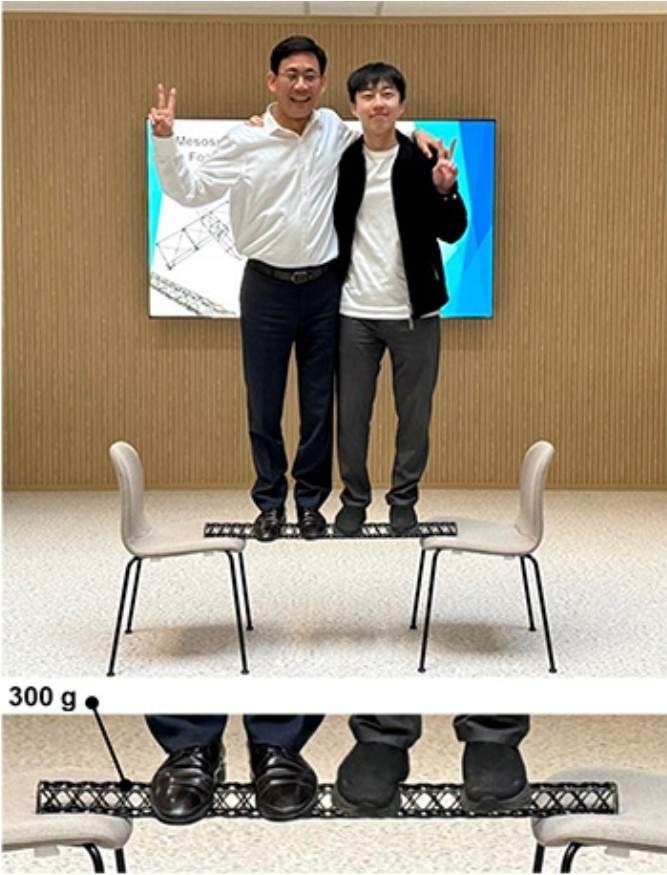
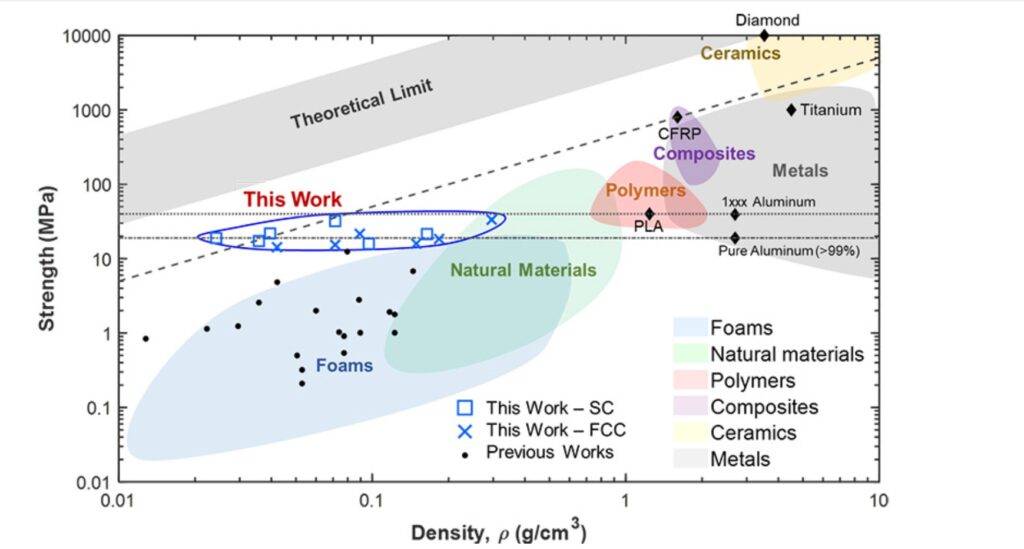
The new carbon fiber lattice structures achieve a compressive strength of 10–30 megapascals, comparable to concrete, while providing a strength-to-weight ratio on par with aluminum at a fraction of the mass. Thanks to continuous load paths, these structures distribute forces more efficiently and minimize inactive material, making them up to ten times stronger than conventional lattice structures of the same weight. To validate the method, the researchers applied the structure to a drone frame. The redesigned frame reduced structural weight by approximately 79% compared to conventional designs, increasing flight time by 33% under the same operating conditions.
Dr. Jun Young Choi and Professor Sung-Hoon Ahn stated that the spatial complexity of continuous fiber architectures has historically limited their scalability in traditional manufacturing. However, with advances in robotics and AI-driven manufacturing technologies, these structures can now be mass-produced, and this work provides a roadmap for their practical application. The technology's impact spans aerospace, mobile systems, robotics, and construction. In aerospace, it can improve range, payload capacity, and energy efficiency; in robotics, it enhances actuation speed and precision; and in construction, it opens pathways for material-efficient load-bearing frames. The method supports a shift from component-based engineering to integrated structural systems defined by geometry, continuity, and automated manufacturing.
This article is compiled by Wedoany. All AI citations must indicate the source as "Wedoany". If there is any infringement or other issues, please notify us promptly, and we will modify or delete it accordingly. Email: news@wedoany.com