U.S. Beef Imports Hit Record High in Q1 2026, Brazilian Exports to U.S. Up 21%
en.Wedoany.com Reported - The U.S. beef industry is facing its most severe structural crisis in decades, with cattle herds continuing to shrink, domestic production falling to near-decade lows, and import demand reaching historic highs. Although President Donald Trump made lowering living costs a core campaign promise, the most sensitive beef prices have not responded to executive orders or tariff measures, instead continuing to climb.
The U.S. livestock industry was once a global benchmark for efficiency, but structural fractures accumulated over the past decade are now converging. Data from the USDA Economic Research Service (USDA/ERS) shows that U.S. beef imports in the first quarter of 2026 increased by 18% year-over-year, forcing massive purchases from Brazil, Australia, Uruguay, Argentina, Nicaragua, and Paraguay to fill the domestic supply gap. Ironically, the U.S., as one of the most advanced countries in beef cattle production technology, remains unmatched in genetics, slaughter facilities, feedlot scale, and logistics, yet its cattle herd has contracted for the seventh consecutive year. As of January 1 this year, the total U.S. cattle inventory was only 86.155 million head, the lowest since 1951; among them, beef cattle numbered 27.6 million head, the lowest level since 1960. Compared to the 2019 peak, the U.S. has lost 4.03 million beef cattle, with the industry's breeding base declining by 12.7%.
The USDA Economic Research Service (USDA/ERS) refers to the 8- to 12-year cycle of cattle herd expansion and contraction as the "cattle cycle." The current cycle entered a contraction phase in 2019, and no market signals have yet reversed this trend at the pace demanded. Drought is a key driver: in 2023, nearly 93% of pastures in states where U.S. beef cattle are located were rated by the USDA National Agricultural Statistics Service (USDA/NASS) as "very poor" to "fair." Hay prices hit records in late 2022 and early 2023. When the cost of raising cattle exceeds income, producers have no choice but to slaughter. Small operators are hit hardest—according to the 2022 Census of Agriculture, the average U.S. breeding operation has about 47 head of cattle, and operations with 100 head or more account for only 10.5% of all operations but hold 60.5% of the inventory. These operations lack the capital to withstand two to three years of losses.
Rebuilding the herd has no shortcuts: a nine-month gestation period, plus 18 to 24 months to reach slaughter weight. Calf production in 2025 was 32.9 million head, down 2% year-over-year and 3.39 million head below the 2018 peak. The USDA Economic Research Service (USDA/ERS) confirmed in February that significant herd expansion is not expected until after 2028.
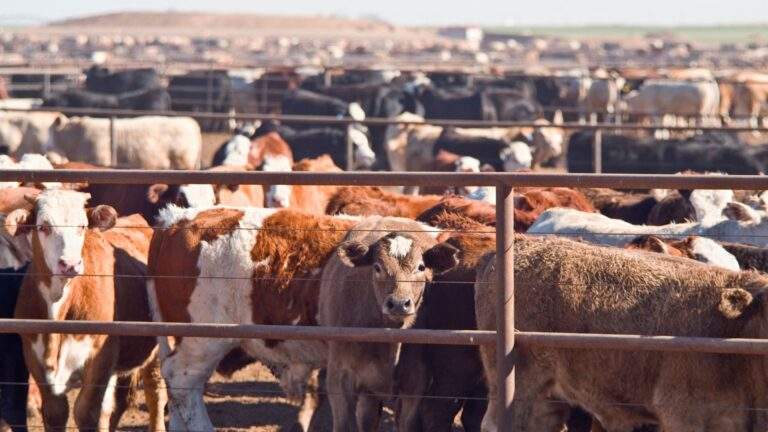
Due to the livestock shortage, the industry had compensated with heavier animals: the average carcass weight increased by 11 kg in 2024, keeping production near 12.25 million tons. But by 2025, this resource was exhausted, and commercial production fell 4% to about 11.8 million tons, the lowest since 2016. Forecast production for 2026 is further reduced to 11.76 million tons.
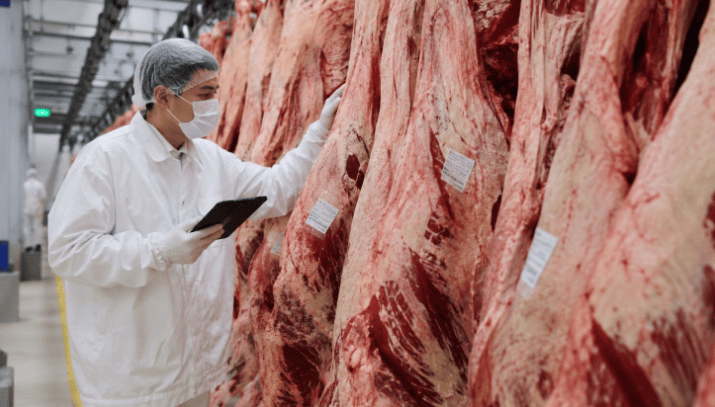
High industry concentration amplifies supply shocks. According to USDA Food Safety and Inspection Service (USDA/FSIS) data, JBS USA, Cargill, Tyson Foods, and National Beef control 77% to 85% of steer and heifer slaughter in the U.S. The four-firm concentration ratio (CR4) has risen from 36% in 1980 to over 80%, a growth unmatched by any other U.S. manufacturing sector. While this concentration improves efficiency and lowers processing costs, a single event can ripple through the entire supply chain—the 2019 fire at a Tyson Foods plant knocked out 6% of national processing capacity; packaged beef prices surged 80% from April to May 2020 during the pandemic; and a 2025 immigration enforcement action in Nebraska reduced a plant's output to 20% of normal capacity. Data from the Center for Economic and Policy Research shows that over 50% of workers in U.S. meat processing plants are foreign-born, with that figure reaching 60% in states like Nebraska and Iowa.
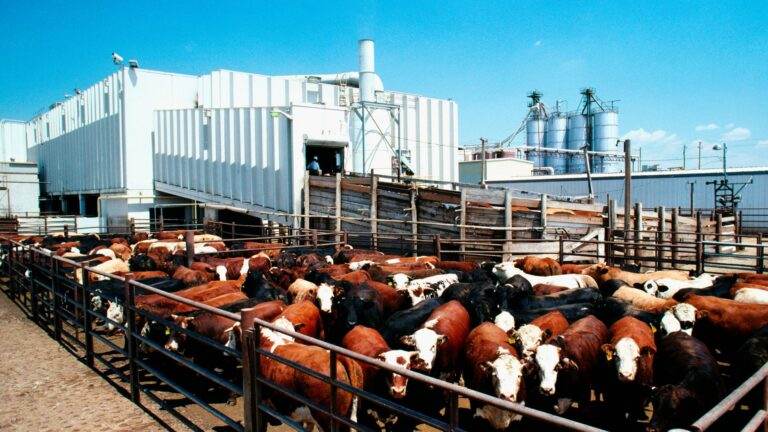
In November 2025, Trump signed an executive order directing the Department of Justice to investigate these four companies for alleged cartel and price-fixing behavior. Acting Attorney General Todd Blanche announced that the DOJ has reviewed over 3 million documents. However, the meat industry association responded that processing plants have been losing money for over a year due to tight livestock supplies and strong demand. USDA data supports this claim: producer prices are at record highs, while processor margins are negative, which is inconsistent with a typical cartel but consistent with a shortage.
The invasion of the New World screwworm has exacerbated the crisis. In the first ten months of 2024, Mexico provided some relief to the U.S. market; according to USDA data, total cattle imports from Mexico reached 1.24 million head, up 21.3% from the same period in 2023. But in November 2024, the U.S. closed the border to cattle imports from Mexico due to this pest. On June 3 this year, the USDA Animal and Plant Health Inspection Service (USDA/APHIS) confirmed the first domestic case since 1966, found in a three-week-old calf in Zavala County, Texas. Agriculture Secretary Brooke Rollins stated that all models indicated the pest would enter the U.S. in 2025. The USDA estimates its spread in Texas would cost the state at least $1.8 billion and jeopardize the entire domestic cattle supply chain.
Against this backdrop, Brazil has become a supplier the U.S. cannot tariff yet must rely on. On June 1, 2026, the Office of the U.S. Trade Representative (USTR) proposed a 25% new tariff on Brazilian products but explicitly excluded beef. U.S. ranchers were not satisfied with this decision. The National Cattlemen's Beef Association (NCBA), R-CALF USA, and the American Farm Bureau Federation jointly believe that importing more beef can address retail price issues in the short term but will deepen structural contradictions. On May 12, R-CALF CEO Bill Bullard stated in a release that "temporarily increasing imported beef supplies could delay the expansion of the U.S. cattle herd." Brazil exports beef to the U.S. under the "Other Countries" tariff-rate quota (TRQ), shared with Japan, Ireland, and others. In 2026, this quota was reduced from 65,005 tons to 52,005 tons, with 13,000 tons transferred to the UK. The market reacted swiftly: on January 5, 2026, 91% of the "Other Countries" quota was already filled; on January 6, Brazil exhausted its tariff-rate quota within six days of the trade year's start. The same point in 2025 was January 17, in 2024 it was March, and in 2023 it was May. Meanwhile, Australia, which holds a bilateral quota of 378,214 tons, had used less than 1% of its quota during the same period.
Since January 7, all Brazilian beef exported to the U.S. has been subject to a 26.4% out-of-quota tariff, but U.S. market demand has not diminished. A weekly report from the USDA Agricultural Marketing Service (USDA/AMS) on May 22 showed that as of the week ending May 16, Brazil had exported 159,729 tons of beef to the U.S., up 12% year-over-year. In the first quarter of 2026, Brazil exported $795 million worth of beef to the U.S., a 21% increase year-over-year. Total U.S. beef imports in the first quarter reached 562,000 tons, valued at nearly $4.5 billion, up 18% year-over-year and 122% higher than five years ago.
Facing record retail prices, the American Farm Bureau Federation stated that the Trump administration is studying a 200-day suspension of quantitative limits under the TRQ system, which would allow unlimited beef imports at reduced tariffs, primarily benefiting Australia, New Zealand, Uruguay, and Argentina—Argentina's quota was already expanded by Trump from 20,000 tons to 100,000 tons in February 2026. Brazil has no dedicated quota and no free trade agreement, so it will continue to compete for residual space and pay the 26.4% out-of-quota tariff. Overall U.S. food inflation was 3.2% over 12 months, while beef prices in April 2026 were up 14.8% year-over-year, with forecasts of an additional 12.1% increase for the remainder of 2026. In 2025, Brazil surpassed the U.S. in global beef production for the first time, with 2026 forecasts at 12.37 million tons for Brazil and 11.741 million tons for the U.S. This country, which had been an exporter for decades, is now buying beef from the nation it once taught, paying extra tariffs to secure supply.
This article is compiled by Wedoany. All AI citations must indicate the source as "Wedoany". If there is any infringement or other issues, please notify us promptly, and we will modify or delete it accordingly. Email: news@wedoany.com
Related Products

4HS-8 High-efficiency Peanut Inverted-laying Harvester
Hebei Yongfa Hongtian Agricultural Machinery Manufacturing Co., Ltd.

714CD Series C-Band Weather Radar
Chengdu Zhongdian Jinjiang Information Industry Co., Ltd.


Industrial and Commercial Point-Type Gas Detector
Jinan Benan Technology Development Co., Ltd.