en.Wedoany.com Reported - Recently, the project "Key Technology Equipment and Application for High-Purity Graphite Purification," jointly developed by China's Shanxi CETC Electronic Equipment Co., Ltd. (Shanxi CETC) and China Minmetals Corporation (China Minmetals), was awarded the First Prize of the 2025 Non-Metallic Mineral Science and Technology Award by the China Non-Metallic Minerals Industry Association. The R&D team overcame three major technical challenges—ultra-high temperature control, furnace chamber gas distribution, and ultra-high vacuum stability—and successfully developed a high-temperature purification furnace capable of efficiently removing graphite impurities under ultra-high temperatures of 2400°C and high vacuum conditions. The product purity reaches 99.99995% (6.5N), achieving an internationally advanced level. Currently, this equipment has entered mass production and been integrated into the production lines of domestic new material and new energy enterprises.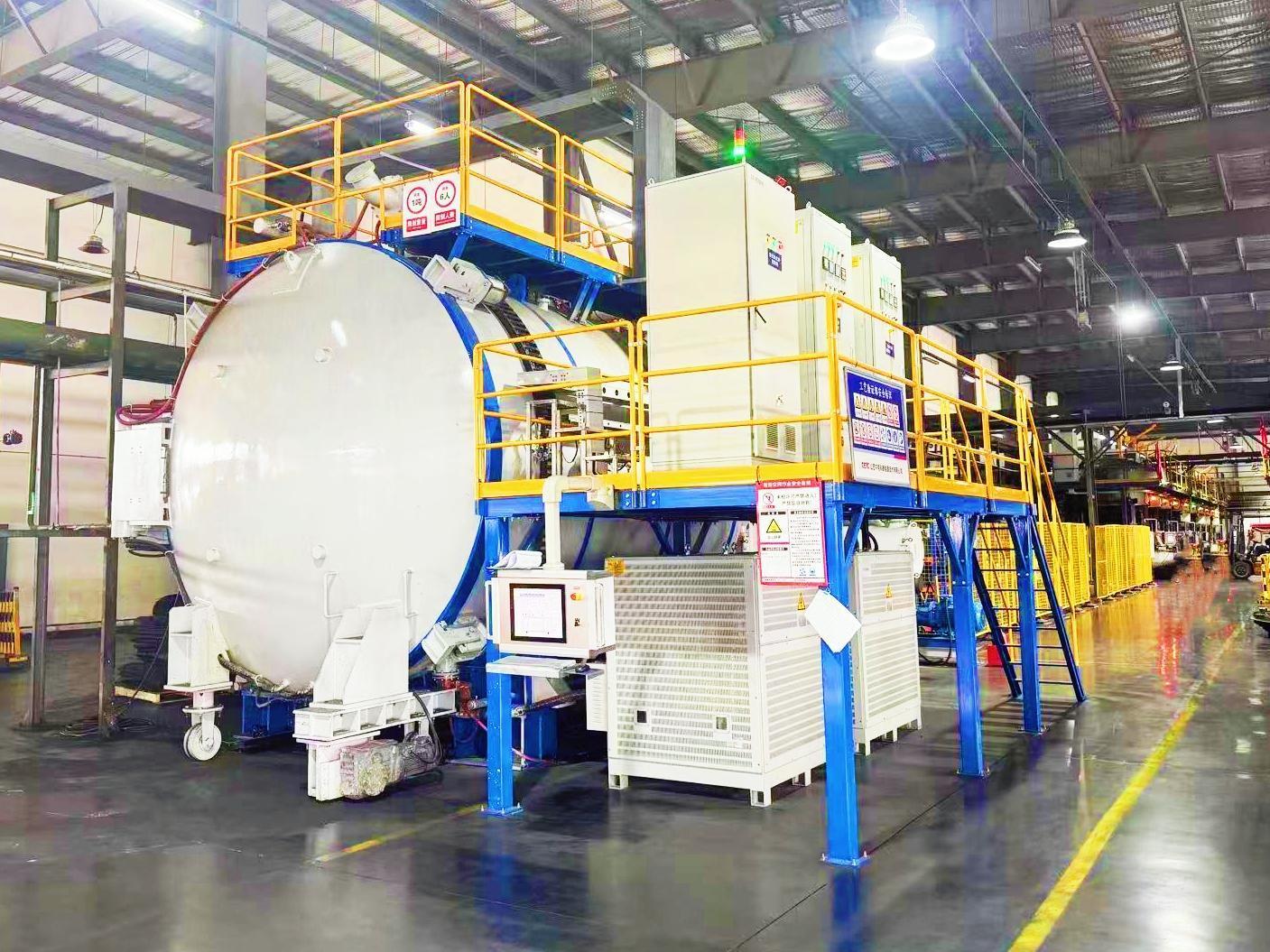
Graphite, known for its electrical conductivity, high-temperature resistance, and corrosion resistance, is hailed as "industrial black gold" in fields such as aerospace and nuclear industry. However, natural graphite typically has a purity of around 95%, while high-precision sectors like semiconductors and aerospace require ultra-high purity graphite with a carbon content of over 99.99%. Previously, high-purity graphite purification equipment was long constrained by foreign technology blockades, with expensive equipment and long supply cycles, severely hindering the development of related industries in China.
In 2018, Shanxi CETC partnered with universities such as Nankai University and North University of China to initiate technical research. The first challenge was temperature monitoring failure—domestic equipment would lose temperature measurement capability when heated to 1800°C. The team switched to infrared non-contact temperature measurement, optimized through hundreds of test groups, and adopted dual-point monitoring with compensation algorithms to control temperature measurement errors within 1°C. Subsequently, the team encountered issues such as heating element fusing and uneven thermal fields. By selecting new high-temperature resistant materials and repeatedly optimizing furnace chamber structure and insulation processes, after hundreds of cold-hot start-stop tests, the equipment ultimately achieved stable operation at a constant 2400°C for extended periods.
The second challenge was furnace chamber gas distribution. During the first prototype test, graphite billets collapsed and toppled. The team discovered that the purification process required not only high temperatures but also uniform and stable directional airflow to remove impurities. The team introduced coupled simulation modeling of airflow fields and heat transfer, modified the furnace chamber internal structure 17 times, and conducted over 100 simulations and on-furnace tests, ultimately overcoming the airflow challenge.
Subsequently, as industry purity requirements increased, maintaining high vacuum under high temperatures became a new challenge. The team broke down the problem into two paths: "fast pumping" and "low leakage." They developed an intelligent linked pumping system, improving pumping efficiency by nearly three times; modified the furnace body sealing structure, using oxygen-free copper knife-edge seals combined with bellows thermal compensation devices to solve high-temperature sealing leakage issues, establishing an ultra-high vacuum process environment at 2400°C and one ten-thousandth of a Pascal. By the end of 2019, China's first independently developed vertical high-temperature purification furnace was officially put into operation. After purification, the product's ash content was below one part per million, key impurity content was below 0.01 ppm, and purity reached 99.99995% (6.5N), achieving an internationally advanced level. In 2024, the equipment underwent intelligent transformation, equipped with an intelligent system capable of automatically generating production processes.
Shanxi CETC is a subsidiary of China Electronics Technology Group Corporation (CETC), focusing on the R&D and manufacturing of key equipment for high-purity carbon-based materials and lithium battery carbon nanotube materials, and is recognized as a national-level specialized and new "Little Giant" enterprise. China Minmetals is China's largest and globally leading comprehensive mining enterprise. Its Wang Jionghui research team has persistently tackled challenges in the field of high-temperature graphite purification, successfully achieving large-scale production of high-end products such as nuclear-grade graphite and ultra-high purity graphite.
This article is compiled by Wedoany. All AI citations must indicate the source as "Wedoany". If there is any infringement or other issues, please notify us promptly, and we will modify or delete it accordingly. Email: news@wedoany.com