en.Wedoany.com Reported - Recently, China University of Mining and Technology (CUMT) achieved a technological breakthrough in the field of 3D reconstruction of mine safety hazard scenarios. The invention patent titled "A Self-Supervised Depth Estimation Method for 3D Reconstruction of Mine Safety Hazard Scenarios," with a team of inventors including Professor Cheng Deqiang and Associate Professor Kou Qiqi, Deputy Director of the Research Center, was officially granted by the China National Intellectual Property Administration, with CUMT as the patent holder. This patent addresses the challenge of depth estimation in complex environments such as low-light and uneven illumination in mines, proposing a self-supervised monocular depth estimation method that significantly enhances underground visual perception and 3D modeling capabilities.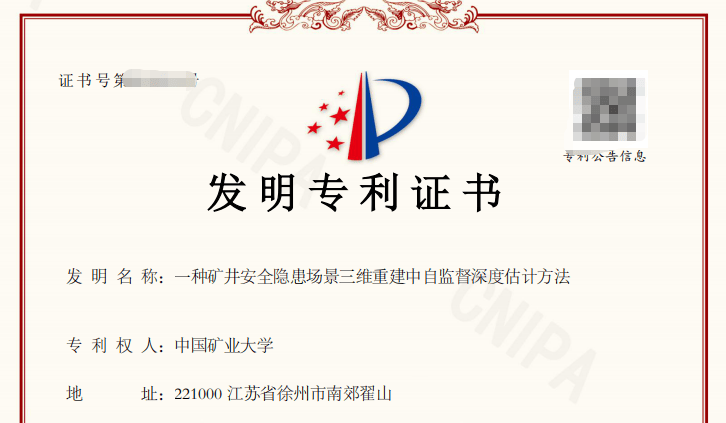
CUMT, a national key university directly under the Ministry of Education located in Xuzhou, Jiangsu Province, is a member of the "211 Project" and "Double First-Class" initiative, with disciplinary strengths in mining engineering, safety science and engineering, and related fields. Professor Cheng Deqiang currently serves as the Dean of the Graduate School at CUMT and the Executive Dean of the National Academy of Excellent Engineers, while also heading the Intelligent Detection and Pattern Recognition Research Center. This research center has long focused on the development of image processing and artificial intelligence algorithms for coal mine underground environments, having developed over 30 types of full-mine video analysis algorithms tailored for special mine working conditions, and produced a series of cloud-edge-device collaborative intelligent analysis cameras, holding numerous core patents and software copyrights.
The granted invention patent proposes a complete technical solution. First, depth estimation networks and pose estimation networks are constructed separately for normal-light images and low-light images. A self-attention mechanism-based position-aware module is introduced between the encoder and decoder to capture global contextual information of the scene structure and obtain better feature representations. During network training, both normal-light images and low-light images processed via a Cycle-Consistent Generative Adversarial Network (CycleGAN) are used simultaneously. A mapping image enhancement algorithm is then applied to process the output images from the generative adversarial network to maintain brightness consistency, addressing issues of low-light and uneven illumination. This method enhances feature representation in details and improves depth estimation performance for complex backgrounds. The mapping image enhancement module significantly increases the brightness and contrast of low-light images, resulting in higher visibility and preserving more details.
The innovations of this patent include: a self-attention position-aware module that aggregates global contextual information to enhance depth feature representation in complex scenes; a dual-path training strategy that uses normal-light depth maps as pseudo-labels to improve estimation accuracy for low-light images; a mapping image enhancement module that boosts the visibility of low-light images through a brightness mapping function; joint optimization combining structural similarity and L1 loss to improve reconstructed view quality; and a lightweight backbone network adapted for embedded deployment in mines. This technology can be applied to mine 3D reconstruction and simulation, underground intelligent monitoring and inspection, safety hazard identification and early warning, mine visualization and remote operation and maintenance, as well as low-light industrial environments such as tunnels and underground engineering. This patent grant provides core technical support at the visual perception level for the intelligent upgrade of coal and non-coal mines.
This article is compiled by Wedoany. All AI citations must indicate the source as "Wedoany". If there is any infringement or other issues, please notify us promptly, and we will modify or delete it accordingly. Email: news@wedoany.com